
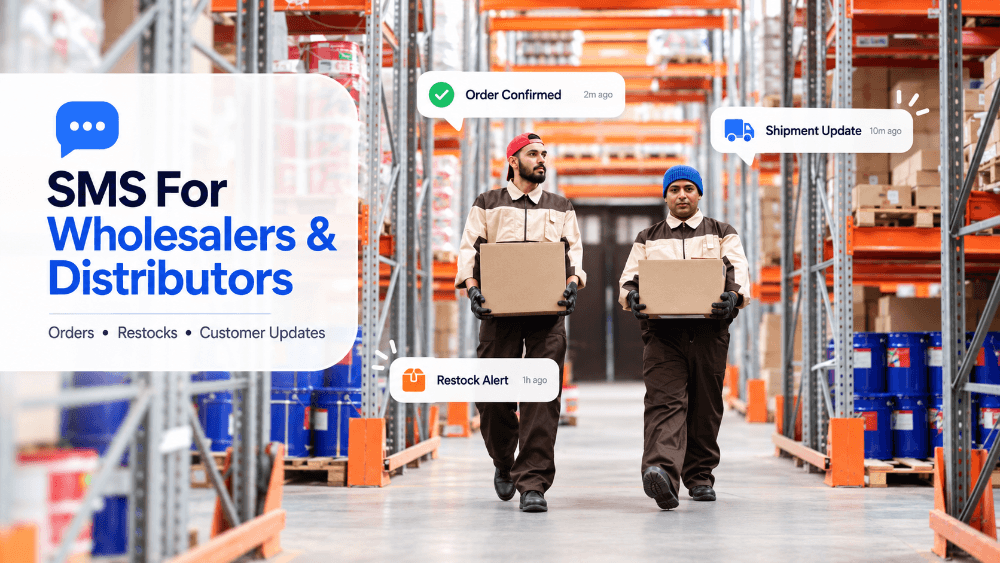
Wholesalers and distributors manage constant communication with retailers, dealers, resellers, contractors, service centers, and other business customers. Buyers need order confirmations, shipping updates, restock notices, backorder information, and product availability updates. Meanwhile, sales teams need an efficient way to keep accounts informed without relying only on email or repeated phone calls.
SMS can make that communication faster.
SMS marketing for wholesalers and distributors allows businesses to send short, timely messages directly to B2B customers. Companies can use texting for operational updates and approved promotional campaigns.
When used correctly, SMS can reduce communication delays, improve reorder activity, and give customers better visibility into orders and inventory.
What Is SMS Marketing for Wholesalers and Distributors?
Wholesale SMS messaging means using text messages to communicate with business buyers throughout the customer relationship.
For example, a distributor might notify a retailer when an order ships. Likewise, a wholesaler could alert approved customers when a high-demand product comes back into stock.
SMS works particularly well for information that has immediate value.
Common Wholesale SMS Use Cases Include:
- Order confirmations
- Shipping and delivery updates
- Restock alerts
- Backorder notifications
- Reorder reminders
- New product announcements
- Limited-time B2B promotions
- Sales representative follow-ups
- Account and payment reminders
However, SMS should complement, not replace, email, B2B portals, ERP systems, and direct sales relationships.
1. Send Order Confirmations Immediately
Once a business customer places an order, a quick confirmation can provide reassurance that the distributor received it successfully.
For example:
“ABC Wholesale: Order #58421 has been received and is being processed. We’ll send another update when it ships.”
The message does not need to include every line item or commercial detail. Instead, it confirms the important event and directs the customer to the appropriate portal or email for complete information.
Additionally, automated order confirmations can reduce routine inquiries from customers asking whether an order went through.
For wholesalers processing hundreds or thousands of orders, this can save considerable administrative time.
2. Keep Customers Updated on Shipping and Delivery
B2B customers often depend on incoming inventory to run their own operations.
A retailer may need products before a promotion starts. Likewise, a repair center may be waiting for parts before completing customer jobs.
Therefore, shipment visibility matters.
A distributor can automatically send SMS messages when an order leaves the warehouse.
For example:
“ABC Distribution: Order #58421 shipped today via DHL. Estimated delivery: Sept. 25. Track here: [link].”
Then, if the delivery schedule changes, the system can send another update.
This proactive communication helps customers plan receiving schedules and inventory availability. It can also reduce calls to customer service teams asking for tracking information.
3. Use Restock Alerts to Capture Existing Demand
Restock messages can be especially valuable in wholesale.
Business buyers often reorder the same products. However, when an item goes out of stock, the buyer may postpone the purchase or look for another supplier.
An SMS alert can bring that customer back when inventory becomes available again.
For example:
“ABC Wholesale: SKU 4820 is back in stock. Existing trade customers can order through the B2B portal: [link].”
Because the customer already expressed interest in the product, the message provides immediate value.
Segment Restock Messages Carefully
Not every customer needs every inventory alert.
Instead, wholesalers can segment contacts according to purchase history, brand interest, category, territory, or previous backorders.
For instance, a distributor of watchmaking supplies could send a restock alert for polishing compounds only to customers who regularly purchase polishing products.
As a result, customers receive more relevant messages while the distributor avoids unnecessary texting costs.
4. Communicate Backorders Before They Become Problems
Poor communication can quickly damage customer relationships when backorders occur.
A retailer expects a shipment, but part of the order does not arrive. Without an update, the customer may assume the distributor made an error.
Therefore, wholesalers should communicate significant inventory problems early.
For example:
“ABC Distribution: Item 7821 in order #58421 is temporarily backordered. Expected availability: Oct. 3. The remaining items will ship as scheduled.”
This message immediately explains the situation.
Moreover, a two-way messaging system lets the buyer request a substitute, contact a sales representative, or ask for more information.
Clear communication cannot eliminate a backorder, but it can make the situation much easier to manage.
5. Send Reorder Reminders Based on Buying Patterns
Many wholesale relationships involve repeat purchases.
Restaurants reorder supplies. Retail stores replenish popular products. Repair businesses regularly need parts, tools, or consumables.
Therefore, previous purchase history can help wholesalers identify useful reorder opportunities.
For example:
“Hi Mark, ABC Supply here. You last ordered Model X filters about 60 days ago. Need another case? Reply YES or order here: [link].”
This type of message works best when it reflects an actual buying cycle.
However, wholesalers should avoid sending generic reorder messages too frequently. A reminder becomes much more valuable when timing and product relevance match the customer’s normal purchasing behavior.
6. Support Sales Representatives With Two-Way SMS
Wholesale sales still depend heavily on personal relationships.
Therefore, automation should support sales representatives rather than replace them.
A sales rep might use SMS to follow up after sending a quote, confirm a call, answer a stock question, or notify a customer about a new product.
For example:
“Hi David, this is Laura from ABC Wholesale. The items we discussed yesterday are now available. Let me know if you’d like me to prepare the order.”
That message feels more conversational than a mass campaign.
A shared business messaging platform can also keep conversations attached to customer records. As a result, the sales team can maintain visibility even if another employee later manages the account.
7. Promote New Products and B2B Offers
Wholesalers can also use SMS for promotional campaigns with the appropriate consent.
For example, a distributor may announce a new product range, a quantity discount, a seasonal promotion, or a dealer-only offer.
“ABC Wholesale: Trade customers get 15% off selected workshop tools through Friday. View products: [link]. Reply STOP to unsubscribe.”
However, promotional messaging requires more careful targeting than transactional updates.
A customer who wants shipping alerts may not automatically want frequent sales messages. Therefore, businesses should keep promotional consent and message preferences clearly organized.
Furthermore, B2B campaigns should provide genuine commercial value rather than repeat information already sent through email.
8. Use SMS for Account and Payment Updates
SMS can also support account administration.
For instance, distributors can remind customers when an invoice approaches its due date or notify them when account documentation requires attention.
A message could say:
“ABC Distribution: Reminder that invoice #88342 is due Sept. 28. Please view your account portal for details.”
However, businesses should avoid placing sensitive financial information directly inside a text message.
Instead, SMS should prompt customers to use a secure portal, contact an account manager, or use an approved payment system.
This keeps the message short while still helping customers take action.
9. Connect SMS With ERP and CRM Systems
Wholesale messaging becomes much more useful when it connects with existing business software.
An ERP system can trigger an SMS when an order changes status. Similarly, a CRM can trigger a follow-up after a sales representative adds a new opportunity.
Other Integrations Might Connect SMS With:
- Inventory management
- Ecommerce platforms
- B2B ordering portals
- Warehouse systems
- Shipping software
- Accounting platforms
As a result, staff don’t need to send routine updates manually.
Automation also helps maintain consistency because customers receive the same type of communication at the same stage of each order.
10. Follow SMS Consent and Opt-Out Best Practices
B2B messaging still requires responsible consent practices.
Businesses should explain who will send the texts, what types of messages recipients will receive, and how recipients can stop future messages.
Operational texts, such as order confirmations, differ from promotional campaigns. Therefore, wholesalers should avoid treating one type of consent as unlimited permission for every future message.
Messaging providers may also require businesses to maintain proof of consent and provide clear opt-out instructions for recurring messages.
For example, customers should be able to use a standard keyword such as STOP to unsubscribe where applicable.
Because requirements differ by jurisdiction, sender type, carrier, and platform, wholesalers should review the rules that apply to their messaging programs.
Build a Better Wholesale SMS Strategy
The best wholesale SMS programs focus on usefulness.
Start with high-value operational messages such as order confirmations, shipping updates, backorders, and restock notifications.
Next, segment customers by account type, product interest, territory, or purchase history.
Also, connect messaging to ERP and CRM data so notifications trigger automatically when relevant events occur.
Finally, monitor delivery, replies, opt-outs, link activity, and customer response.
The goal is not to send more messages. Instead, send fewer, more useful messages at the moments when B2B customers actually need them.

Final Thoughts
SMS gives wholesalers and distributors a practical way to improve communication with business customers.
Order confirmations can provide immediate reassurance, while shipping and backorder alerts improve visibility. Meanwhile, restock notifications and reorder reminders can help customers act quickly when inventory becomes available.
Two-way messaging can also strengthen relationships between sales representatives and business accounts.
However, successful wholesale SMS depends on relevance, timing, segmentation, automation, and proper consent.
When wholesalers connect SMS with their existing sales, inventory, and order systems, text messaging can become a valuable part of the B2B customer experience, not another disconnected marketing channel.