
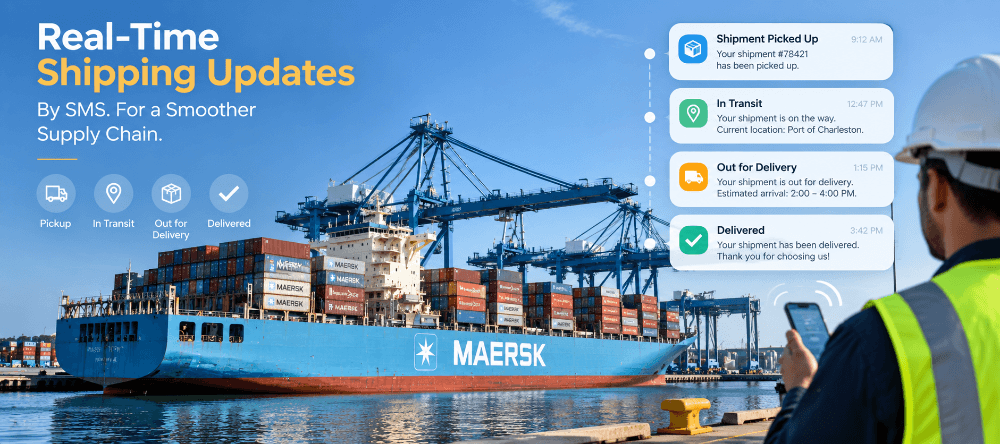
Customers no longer want to wonder where a shipment is. Whether they are waiting for a pallet, e-commerce order, replacement part, or time-sensitive freight delivery, they expect clear updates throughout the journey.
However, logistics communication often involves several systems, carriers, warehouses, dispatchers, drivers, and customers. As a result, important information can become fragmented across portals, emails, phone calls, and transportation management systems.
SMS offers a simpler communication layer. Logistics and freight companies can send real-time pickup confirmations, estimated arrival times, delay alerts, delivery notifications, and exception updates directly to a customer’s phone.
Moreover, businesses can automate many of these messages using transportation or order-management data. As a result, staff spend less time answering “Where is my shipment?” calls while customers receive information when it matters.
Why SMS Works Well for Logistics Communication
Logistics messages usually contain short, time-sensitive information. Therefore, they fit naturally into SMS.
A customer rarely needs a lengthy email to learn that a truck will arrive 30 minutes late. Instead, a concise text can communicate the change immediately.
Common logistics SMS messages include:
- Shipment booked
- Freight picked up
- Driver dispatched
- Shipment in transit
- Estimated arrival time
- Delivery appointment reminder
- Delay or disruption
- Customs update
- Failed delivery attempt
- Proof of delivery
- Pickup-ready notification
- Delivery confirmation
SMS also doesn’t require customers to log into a tracking portal every time they want an update.
That convenience can become especially valuable for urgent freight, B2B deliveries, field-service parts, and last-mile logistics.
Real-Time Shipment Updates Reduce Customer Uncertainty
Shipment tracking becomes frustrating when customers see only broad statuses such as “in transit.”
Instead, SMS can turn transportation events into useful customer updates.
For example:
“NorthStar Freight: Shipment #72841 left our Atlanta terminal at 9:20 AM. Estimated delivery: 2:00–4:00 PM today.”
A later message might say:
“Update: Traffic has delayed Shipment #72841. New ETA: approximately 4:45 PM.”
The second message matters because it arrives before the customer starts wondering what happened.
Proactive communication shifts the customer experience from uncertainty to visibility.
In logistics, that difference can also help warehouses prepare docks, businesses schedule employees, and receivers avoid unnecessary waiting.
Connect SMS With Transportation Management Systems
Manual shipment updates do not scale.
A freight company handling hundreds or thousands of loads cannot ask dispatchers to type every status update individually.
Therefore, the strongest SMS programs connect messaging with transportation management systems (TMS), warehouse systems, fleet-management software, ecommerce platforms, or other operational tools.
A typical workflow may look like this:
- The TMS records a shipment milestone.
- The system triggers an SMS event.
- The messaging platform retrieves the customer’s phone number and shipment details.
- The customer receives the appropriate update.
- Delivery and response data return to the business system.
For example, geofencing could trigger a message when a truck reaches a specific distance from the destination.
As a result, texting becomes part of the logistics workflow instead of another manual task.
Use SMS Across the Shipment Lifecycle
A well-designed SMS strategy should match the customer journey.
| Shipment Stage | Useful SMS Update |
|---|---|
| Booking | Confirm shipment details |
| Pickup scheduled | Share pickup window |
| Freight collected | Confirm successful pickup |
| In transit | Send status or ETA |
| Delay detected | Explain updated timing |
| Near destination | Alert receiving team |
| Delivered | Confirm completion |
| Exception | Give next steps |
The key is to send meaningful milestones, not every internal scan.
For instance, a customer probably does not need six messages while freight moves between internal terminals overnight.
However, they may value an alert if the ETA changes by several hours.
Therefore, companies should design alerts around decisions customers need to make.
Delivery Appointment Reminders Reduce Failed Deliveries
Large freight deliveries often require someone to be available at the destination.
As a result, missed appointments create expensive problems. Drivers may wait, terminals may charge redelivery fees, and shipments may need to return to a facility.
SMS reminders can reduce these situations.
For example:
“Reminder from Atlas Freight: Your delivery is scheduled tomorrow between 10 AM and noon. Reply YES to confirm someone will be available.”
If the customer replies NO, the logistics team can address the issue before the driver arrives.
Additionally, a second notification can go out when the driver approaches:
“Your delivery is approximately 30 minutes away. Please ensure the receiving area is accessible.”
That type of message gives customers enough time to prepare.
Delay Alerts Are More Valuable Than Perfect ETA Promises
Delays happen in logistics.
Traffic, weather, terminal congestion, mechanical issues, customs, loading problems, and failed pickups can all affect delivery schedules.
The communication problem begins when customers learn about the delay too late.
Therefore, logistics SMS should prioritize exception management.
A useful delay message includes:
- Shipment identification
- What changed
- Updated ETA when available
- What the customer needs to do
For example:
“Shipment #15672 is delayed due to severe weather. Estimated delivery has moved from Tuesday to Wednesday morning. No action is required.”
This message is more useful than leaving customers to discover the delay through a tracking portal.
Furthermore, companies should avoid making overly precise promises when operational data remains uncertain. A realistic delivery window often creates a better experience than an ETA that changes repeatedly.
Driver-to-Customer Texting Can Improve Last-Mile Delivery
Last-mile communication often requires coordination between the driver and recipient.
Customers may need to provide gate information, building access, loading-dock instructions, or directions.
Two-way business texting allows that communication without requiring drivers to expose personal phone numbers.
For example:
- Driver: “This is Metro Logistics. I’m about 20 minutes from your delivery. Which entrance should I use?”
- Customer: “Use Gate B behind the warehouse.”
- Driver: “Thanks. I’ll arrive at Gate B.”
This simple exchange can prevent delays.
However, companies should centralize business conversations whenever possible. Shared inboxes, driver-assignment systems, and business numbers help preserve records and keep communication professional.
SMS Can Reduce “Where Is My Order?” Support Volume
A major benefit of proactive logistics messaging involves customer-service efficiency.
If customers receive clear updates automatically, fewer people need to call support to request information the company already has.
Consider a shipment with these automated updates:
- Pickup completed
- In transit
- Delivery tomorrow
- Driver 30 minutes away
- Delivered successfully
Customers rarely need to contact the company for basic tracking.
As a result, support staff can focus on exceptions, claims, damaged freight, billing disputes, and other complex issues.
Moreover, the company creates a better experience without increasing employee workload.
Personalize Messages With Shipment Data
Generic texts can confuse customers managing multiple deliveries at once.
Therefore, logistics companies should personalize messages with relevant operational data.
Useful fields include:
- Customer or company name
- Shipment number
- Order number
- Origin
- Destination
- Scheduled date
- ETA
- Driver status
- Delivery window
For example:
“Acme Manufacturing: Shipment #88210 from Chicago is scheduled to arrive at your Dallas facility tomorrow between 1–3 PM.”
That message immediately tells the receiver which shipment the alert concerns.
However, companies should avoid adding unnecessary sensitive information. Customers need enough context to recognize the shipment, not an entire freight record inside one SMS.
Use SMS for Freight Exceptions and Action Requests
Some logistics messages require a response rather than passive notification.
For example:
“Shipment #62418 requires a delivery appointment. Reply 1 for Thursday morning or 2 for Thursday afternoon.”
Other action-based SMS workflows could support:
- Appointment confirmation
- Address verification
- Delivery-window selection
- Pickup confirmation
- Rescheduling
- Documentation requests
- Driver access instructions
As a result, SMS can turn logistics notifications into two-way workflows.
When customers can solve a simple scheduling problem by replying with one number, both sides save time.
Measure Logistics SMS Performance
Companies should connect messaging performance with operational outcomes.
Useful metrics include:
| Metric | Business Value |
|---|---|
| Delivery rate | Shows whether customers receive alerts |
| Response rate | Measures engagement with action requests |
| Appointment confirmation rate | Helps reduce failed stops |
| WISMO inquiry reduction | Measures fewer tracking calls |
| Failed delivery rate | Shows operational impact |
| Reschedule rate | Reveals whether alerts prevent wasted trips |
| Response time | Tracks service efficiency |
| Opt-out rate | Signals excessive or irrelevant messaging |
Businesses can also compare operational periods before and after implementing SMS.
For instance, if missed delivery appointments fall after adding 24-hour and 30-minute alerts, the company can estimate the cost savings from fewer redeliveries.
Therefore, SMS ROI should include operational efficiency, not only marketing conversions.
Separate Operational Alerts From Promotional SMS
Logistics companies should distinguish essential shipment communication from marketing messages.
A customer who provides a phone number for delivery notifications does not automatically expect promotional freight offers.
Therefore, companies should define consent clearly and keep messaging aligned with the purpose the customer agreed to.
For promotional SMS in the United States, businesses should follow TCPA requirements, carrier policies, sender registration, and opt-out handling.
Additionally, companies should make STOP requests easy to process and maintain accurate consent records.
Clear preference management can also help. For example, customers may want urgent shipment alerts while declining nonessential promotional campaigns.

The Best Logistics SMS Programs Focus on Useful Moments
SMS gives logistics and freight companies a direct way to communicate during the moments customers care about most.
Pickup confirmations show that freight has started moving. ETA messages help receivers plan. Delay alerts reduce uncertainty. Meanwhile, delivery notifications and two-way coordination can prevent expensive failed stops.
However, successful logistics texting does not mean sending a message for every scan or internal event.
Instead, the strongest programs identify customer-facing milestones and automate communication around them.
Ultimately, SMS can turn shipment tracking from a passive portal into proactive communication. When logistics companies connect texting with real-time operational data, customers gain better visibility while dispatchers, drivers, and support teams spend less time answering routine questions.