
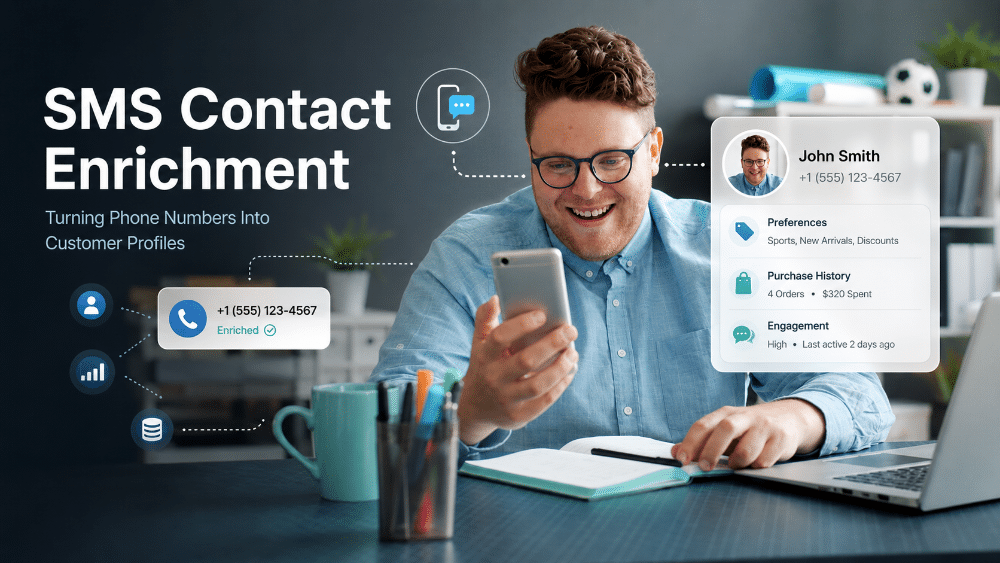
An SMS subscriber often enters a marketing database as little more than a phone number.
That may be enough to send a welcome text, but it tells marketers almost nothing about who the customer is, what they want, whether they have purchased before, or which messages are likely to matter.
SMS contact enrichment solves this problem by connecting a phone number with additional first-party customer information, such as preferences, purchases, website behavior, loyalty status, location, and campaign engagement.
As a result, a basic phone number can become part of a richer customer profile.
However, enrichment should not mean collecting as much information as possible. Instead, businesses should connect useful, permissioned data that helps them communicate more accurately and reduce irrelevant messages.
What Is SMS Contact Enrichment?
SMS contact enrichment is the process of adding useful customer attributes, behaviors, and identifiers to a contact record that initially contains a phone number.
For example, an SMS profile might start with:
Phone: +1 555 123 4567
After Enrichment, the Profile Could Include:
- First name
- Email address
- Customer ID
- City or region
- SMS consent status
- Product interests
- Purchase history
- Loyalty tier
- Average order value
- Last website visit
- Recent SMS clicks
- Preferred store
- Customer-service history
As a result, marketers have more context for deciding when and why to text that person.
Customer-data platforms increasingly use identity resolution to combine identifiers such as phone numbers, email addresses, anonymous browser IDs, and customer IDs into unified profiles. Segment, for example, supports identity resolution through identifiers and identity graphs that connect customer activity across different touchpoints.
Why Phone Numbers Alone Limit SMS Marketing
A list of 100,000 phone numbers may look valuable. But if every subscriber looks the same, marketers have few options beyond broad campaigns.
Suppose a clothing retailer sends:
“20% off everything this weekend.”
The Campaign Might Reach:
- Someone who purchased yesterday
- A VIP customer who rarely needs discounts
- A shopper interested only in children’s clothing
- Someone who abandoned a men’s shoe cart
- A subscriber who has not engaged in a year
Sending the same message to all five ignores important context.
Enriched profiles allow the business to treat those subscribers differently.
| Basic Contact | Enriched Customer Profile |
|---|---|
| Phone number | Phone + customer ID |
| Opt-in date | Full consent history |
| No purchase context | Purchase history |
| Unknown interests | Product preferences |
| Basic campaign history | Cross-channel engagement |
| Same treatment as everyone | Personalized customer journey |
As a result, enrichment improves segmentation quality before marketers even start writing the message.
Identity Resolution Connects SMS With Other Customer Data
One of the hardest parts of contact enrichment involves recognizing that multiple data points belong to the same person.
A customer might first browse a website anonymously. Later, they subscribe to SMS, create an account with an email address, and eventually make a purchase.
Without identity resolution, those actions may remain separated across several records.
Modern Customer-data Systems Attempt to Connect Identifiers Such as:
- Phone number
- Email address
- Customer ID
- Device identifier
- Loyalty ID
- Ecommerce account
- CRM contact ID
Once the system connects these identifiers, marketers can build a more complete profile.
For example, Twilio Segment’s identity-resolution system uses identifiers and identity graphs to unify customer activity into profiles. This infrastructure lets businesses connect SMS behavior with events from websites, apps, CRMs, and other sources.
As a result, SMS becomes part of the broader customer journey rather than an isolated marketing database.
First-Party Data Provides the Most Valuable Enrichment
Businesses do not necessarily need external databases to enrich SMS contacts.
In many cases, their most useful information already exists inside their own systems.
First-party Enrichment Sources Include:
- Ecommerce purchases
- Website activity
- CRM records
- Loyalty programs
- Customer surveys
- SMS replies
- Link clicks
- Mobile-app activity
- Customer-support interactions
- Appointment systems
- Email engagement
For example, a customer who buys running shoes can gain a “running” interest attribute. Similarly, someone who consistently shops at one physical location can gain a preferred-store attribute.
SMS can also generate enrichment data.
A business might ask:
“What are you most interested in? Reply 1 for running, 2 for hiking, or 3 for gym training.”
The response gives the customer direct control over the preference while improving future targeting.
Zero-Party Data Makes Profiles More Accurate
Behavioral data can suggest what a customer wants. However, directly asking the customer can sometimes provide a better answer.
Zero-party data refers to information customers intentionally provide about their preferences, needs, or plans.
SMS can collect this information naturally through short conversations.
For example:
Business: “Which deals would you like to receive?”
Customer: “Men’s watches.”
The business can then add “Men’s watches” to the customer’s profile and avoid sending unrelated promotions.
Businesses Could Also Ask About:
- Preferred product categories
- Local store
- Desired appointment times
- Communication frequency
- Budget range
- Interests
- Size or fit preferences
As a result, marketers rely less on assumptions.
However, companies should keep these interactions short. Customers joined a text list, not a lengthy research survey.
Behavioral Enrichment Reveals Customer Intent
Profile enrichment becomes especially powerful when businesses add behavioral signals.
Suppose a customer has:
- Viewed the same product four times
- Clicked two previous SMS campaigns
- Added an item to the cart
- Checked the shipping page
- Not completed checkout
Those actions indicate much more intent than a simple demographic attribute.
A Customer-data System Can Add or Calculate Attributes Such as:
Cart status: Abandoned
Product interest: Trail shoes
SMS engagement: High
Purchase intent: Strong
The business might then send:
“Still considering the TrailPro shoes? Your size is currently available. View them here: [link].”
The message feels relevant because the profile contains recent behavioral context.
Therefore, enrichment provides the foundation for predictive segmentation and AI-powered SMS personalization.
SMS Replies Can Enrich Profiles in Real Time
Two-way messaging creates another valuable source of customer information.
Every reply can reveal intent.
For example:
“Do you have this in blue?”
could indicate color preference and product interest.
“I need an appointment next Tuesday.”
could indicate scheduling intent.
“I’m only interested in commercial plans.”
could help a sales team classify the lead.
AI systems can increasingly analyze conversational messages and extract structured information from natural-language replies. As a result, businesses can update CRM or customer profiles without forcing customers through rigid forms.
However, AI-generated profile updates need controls. Businesses should verify high-impact information rather than assuming every conversational inference is accurate.
AI Makes Contact Enrichment More Useful
AI can help transform raw profile data into useful marketing decisions.
A traditional enriched profile might contain 50 individual attributes. A marketer then has to decide which ones matter.
AI can analyze combinations of signals and produce useful predictions, such as:
- Purchase propensity
- Churn risk
- Product affinity
- Expected lifetime value
- Preferred communication channel
- Likelihood to respond to SMS
- Discount sensitivity
Therefore, enrichment becomes more than simply adding database fields.
For example, two subscribers may share similar demographic profiles but behave very differently.
- Customer A buys frequently without discounts.
- Customer B purchases only after receiving promotional offers.
AI can use their enriched histories to recommend different SMS strategies.
As a result, Customer A might receive early product access, while Customer B receives a targeted promotion.
Enrichment Can Prevent Irrelevant Messages
Contact enrichment is valuable not only because it helps businesses send more personalized texts.
It can also help them avoid sending messages.
Suppose a customer purchases a television Monday morning.
A poorly synchronized SMS database might still send:
“Still thinking about that TV? Save 10% today.”
The experience feels careless.
However, if purchase data updates the customer profile in near real time, the system can remove that person from the abandoned-product campaign and start a post-purchase journey instead.
Similarly, Enriched Profiles Can Suppress Messages for:
- Customers who already converted
- Subscribers outside a service area
- Customers without relevant product interests
- Recently contacted subscribers
- People with low SMS engagement
- Contacts who changed communication preferences
Therefore, profile quality directly affects message relevance and frequency.
Data Quality Matters More Than Profile Size
A profile containing 100 attributes is not automatically better than one containing ten.
Incorrect enrichment can create worse marketing than no enrichment at all.
Common problems include:
- Duplicate customer records
- Old phone numbers
- Incorrect identity matches
- Outdated preferences
- Missing consent information
- Conflicting CRM data
- Unverified AI inferences
Businesses should therefore prioritize reliable attributes that influence customer experience.
A useful rule is simple:
If the data will not change how you serve or communicate with the customer, you may not need it.
Teams should also establish which system owns each important attribute. For example, an ecommerce platform may serve as the source of truth for purchase history, while a consent-management system owns SMS permission records.
Privacy and Consent Must Guide Enrichment
Phone numbers are personal identifiers, and enriched customer profiles can contain much more sensitive context than a basic contact list.
Therefore, businesses need a clear data-governance strategy.
They should:
- Collect SMS consent properly.
- Keep consent records.
- Explain relevant data uses.
- Limit data collection to legitimate needs.
- Protect customer profiles.
- Restrict employee and system access.
- Honor opt-outs promptly.
- Correct inaccurate information.
- Follow applicable privacy laws and messaging rules.
Most importantly, businesses should not assume that SMS consent automatically gives unlimited permission to collect or use unrelated third-party data.
Contact enrichment should improve the customer relationship rather than make customers feel monitored.
How to Build an SMS Contact Enrichment Strategy
Businesses can start with a relatively simple process.
1. Identify Core Customer Data
Begin with attributes that clearly improve messaging, such as purchase history, preferences, loyalty status, and engagement.
2. Connect Customer Identifiers
Link phone numbers with CRM IDs, ecommerce profiles, email records, or loyalty accounts where appropriate.
3. Capture Behavioral Events
Track actions such as product views, purchases, cart activity, and SMS clicks.
4. Ask Customers Directly
Use short SMS questions, forms, and preference centers to collect accurate zero-party data.
5. Update Profiles Continuously
Customer interests change. Therefore, profiles should change with them.
6. Activate the Data
Use enriched attributes for segmentation, personalization, suppression, AI prediction, and customer journeys.
7. Measure Whether Enrichment Helps
Track conversion rates, response rates, opt-outs, revenue per recipient, and message frequency.
If enrichment creates more data but no better customer decisions, it doesn’t deliver enough value.

From Phone Numbers to Useful Customer Context
SMS contact enrichment changes a phone number’s role.
Instead of serving only as a destination for promotional texts, the number can connect to a broader customer profile that includes preferences, transactions, behaviors, and engagement history.
That context helps businesses determine who should receive a message, what information matters, and when texting makes sense.
Moreover, enriched profiles provide the foundation for AI-powered personalization, predictive segmentation, conversational SMS, and smarter omnichannel journeys.
However, better profiles should result in better communication—not simply more data.
Ultimately, the goal of SMS contact enrichment is to understand enough about customers to make each interaction more useful while respecting their privacy and preferences.
When businesses achieve that balance, a simple phone number can become the starting point for a much more relevant customer relationship.