
Business texting has traditionally asked customers to trust an unfamiliar phone number.
A promotional SMS may contain the correct brand name, a legitimate link, and a useful offer. However, the recipient still sees a 10-digit number or short code that may look similar to thousands of other business senders.
Branded messaging changes that experience.
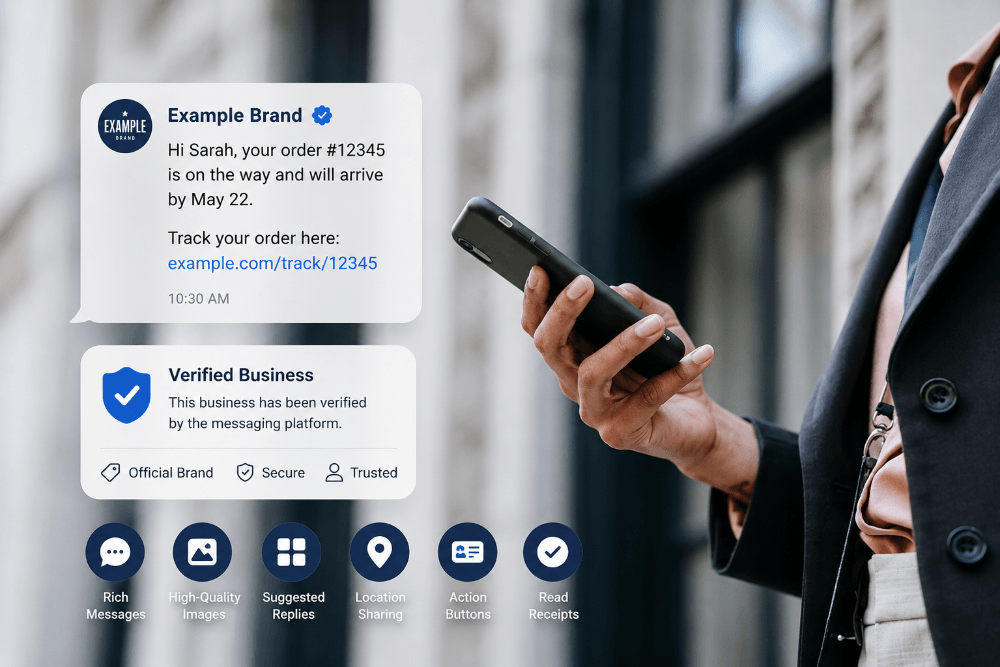
Through technologies such as RCS Business Messaging, companies can increasingly communicate through verified sender profiles that show recognizable brand names, logos, and verification indicators directly inside the customer’s native messaging app.
As a result, business texting is shifting from anonymous numbers to identifiable digital identities.
This shift could improve trust, reduce hesitation, and create richer customer journeys. However, verified messaging does not eliminate the need for SMS. Instead, the future will likely combine branded RCS experiences with reliable SMS fallback.
What Is Branded Messaging?
Branded messaging allows a business to present recognizable identity information when communicating with customers through supported messaging channels.
Instead of displaying only: +1 555 123 4567, a supported business conversation may display: Example Brand ✓
alongside a company logo and other profile information.
RCS for Business takes this approach further by replacing the traditional phone-number identity with a branded sender profile.
Depending on the Implementation, Businesses Can Add:
- Brand name
- Company logo
- Verification indicator
- Business description
- Rich media
- Suggested replies
- Action buttons
- Product carousels
- Location features
- Delivery and read receipts
Therefore, branding becomes part of the messaging experience rather than something marketers must communicate entirely within the message body.
What Is a Verified Sender?
A verified sender is a business messaging identity that has completed a verification process designed to confirm that the sender legitimately represents the brand.
For RCS for Business, verification occurs before an agent launches publicly. The process requires an authorized brand representative to confirm information about the business and the messaging agent.
After verification and launch, supported messaging experiences can display a verification checkmark beside the sender’s name.
That matters because sender authentication addresses one of business texting’s biggest weaknesses: customers often cannot immediately determine whether an unfamiliar message really came from the company it claims to represent.
However, verification should not imply that every message is inherently trustworthy or safe. Customers should still avoid suspicious requests, while businesses must continue protecting their accounts and messaging infrastructure.
Why Sender Identity Matters More Than Ever
Consumers receive more legitimate notifications alongside phishing attempts, fake delivery messages, impersonation scams, and unwanted marketing.
As a result, unfamiliar numbers can create hesitation.
Consider these two inbox experiences:
| Traditional SMS | Branded Messaging |
|---|---|
| +1 555 867 5309 | Example Brand ✓ |
| Unknown sender | Recognizable company |
| Brand identification relies on text | Brand visible before reading |
| Limited visual identity | Logo and profile |
| Basic text and links | Rich interactive content possible |
The message content could remain identical, yet the second interaction provides much more context.
Therefore, verified identity can reduce one step in the customer’s decision process: determining who actually sent the message.
RCS Is Driving the Shift Toward Branded Business Texting
RCS Business Messaging represents one of the strongest drivers behind branded messaging.
Unlike traditional SMS, RCS business messaging does not need to identify the sender primarily through a standard phone number. Instead, customers can interact with an approved branded profile.
Furthermore, RCS supports much richer experiences.
A Business Can Combine Its Identity With:
- High-quality images
- Videos and GIFs
- Rich cards
- Interactive buttons
- Suggested responses
- Multiple-product carousels
- Location sharing
As a result, the messaging inbox can function more like an interactive brand experience.
For example, a travel company could send a verified flight update with buttons to check in, view the boarding pass, change the reservation, or contact support.
The customer receives both clear sender identity and useful actions in one conversation.
Verified Messaging Can Strengthen Customer Trust
Trust plays an important role in whether customers click links, respond to messages, or provide information.
Suppose a banking customer receives:
Your account requires attention. Click here.
If the message arrives from an unfamiliar number, the customer may hesitate—and that hesitation may actually be wise.
Now imagine the same communication appearing in a verified branded conversation with a recognizable bank name and logo.
The additional identity signals can help customers evaluate the message more confidently.
Verified Messaging May Therefore Prove Particularly Useful for:
- Financial notifications
- Delivery updates
- Travel information
- Appointment reminders
- Account alerts
- Customer support
- Loyalty programs
- Ecommerce updates
Nevertheless, companies should never use verification as an excuse to ask customers for sensitive information unnecessarily.
Trust still depends on responsible communication.
Branding Can Improve Marketing Recognition
Sender verification provides security value, but branding also creates marketing benefits.
Traditional SMS campaigns often spend valuable characters identifying the sender:
ACME Shoes: Our weekend sale starts today…
With a branded RCS sender, the customer may already see ACME Shoes and its logo at the top of the conversation.
Therefore, the message can focus more directly on the offer.
Moreover, Consistent Brand Presentation Creates Continuity Between:
- Website
- Mobile app
- Physical stores
- SMS
- RCS
- Customer support
That consistency matters because customers increasingly move between channels during the same purchase journey.
Branded Messaging Goes Beyond Displaying a Logo
A common mistake is treating branded messaging as a cosmetic upgrade.
The larger opportunity involves combining trusted identity with interaction.
For example, a retailer could send a verified RCS message containing three product cards.
Each Could Include:
- Product image
- Product name
- Price
- Shop button
Similarly, an Appointment-based Business Could Provide:
- Confirm
- Reschedule
- Get Directions
Therefore, verification and rich messaging reinforce each other.
Brand identity reassures customers about who is communicating, while interactive features reduce the steps required to respond.
Verified Senders May Help Conversational Commerce Grow
Business messaging increasingly involves conversations rather than one-way promotions.
Customers can ask:
“Do you have this in size 10?”
or:
“Can I change my booking to tomorrow?”
When that conversation occurs inside a verified branded channel, businesses can create an experience that feels more like chatting directly with an official company representative.
AI agents could expand this model further.
For Example:
- Customer receives a verified RCS promotion.
- Customer asks about product availability.
- AI checks inventory.
- Agent presents relevant products.
- Customer selects one.
- Agent sends a purchase or reservation action.
- Human support takes over if necessary.
As a result, branded messaging could become an important interface for conversational commerce.
SMS Still Has an Essential Role
RCS adoption is expanding, including support on Android and compatible iOS devices. However, RCS availability still depends on the recipient’s device, carrier, settings, and market.
Therefore, businesses cannot assume every customer will receive an RCS message.
This makes SMS fallback essential.
Modern messaging infrastructure can check whether a customer can receive RCS. If not, the platform can deliver an SMS or MMS alternative.
A practical architecture looks like this:
RCS-capable customer → Branded RCS experience
Non-RCS customer → SMS fallback
This model protects reach while gradually increasing the percentage of customers who receive richer branded communication.
Providers also let businesses control which SMS number handles fallback. That can help companies preserve regional, departmental, or representative identities even when RCS is unavailable.
Businesses Still Need 10DLC, Toll-Free, and Short Codes
Branded RCS does not automatically eliminate existing SMS sender types.
Businesses may continue using:
- 10DLC numbers
- Toll-free numbers
- Short codes
- Alphanumeric sender IDs where supported
These senders can provide fallback coverage and support customers who cannot receive RCS.
For example, a national company might use one verified RCS profile while falling back to its toll-free number.
Meanwhile, another organization could use one branded RCS identity while selecting different 10DLC fallback numbers for individual locations.
Therefore, the future will probably involve sender orchestration rather than one universal sender type.
Verification Does Not Replace Consent
A verified logo does not permit businesses to message anyone they want.
Consent requirements still apply.
Companies Should Continue to:
- Gain appropriate permission.
- Explain what customers are joining.
- Maintain consent records.
- Honor STOP requests.
- Identify promotional programs clearly.
- Respect message-frequency expectations.
- Protect customer information.
Moreover, verification programs themselves may enforce content and quality rules.
Therefore, businesses should think of verification as an additional trust layer—not a replacement for responsible SMS practices.
How Businesses Should Prepare for Branded Messaging
Companies do not need to abandon their current SMS strategy.
Instead, they can prepare gradually.
1. Strengthen Brand Identity
Keep business names, websites, logos, and company details consistent across platforms.
2. Clean Up Messaging Infrastructure
Maintain registered and stable 10DLC, toll-free, or short-code senders for SMS.
3. Explore RCS Verification
Identify customer journeys where branded identity and rich interaction could provide meaningful value.
4. Configure SMS Fallback
Make sure customers still receive essential communication when RCS is unavailable.
5. Design Rich Experiences Carefully
Use buttons, cards, and media only when they reduce customer effort.
6. Measure Performance
Compare delivery, clicks, replies, conversions, read activity, and customer-service outcomes across RCS and SMS.
As a result, businesses can adopt branded messaging without disrupting established communication.+

The Future of Business Texting Is Identity-Based
Business texting is gradually moving from phone-number-first communication toward verified brand identity.
SMS will remain essential because of its reach and simplicity. However, RCS adds something traditional SMS cannot provide as easily: a rich, recognizable, verified business presence inside the native messaging inbox.
That evolution could change how customers perceive commercial texting.
Instead of asking:
“Who is this number?”
customers may increasingly see the company identity before opening the conversation.
Furthermore, verified sender profiles can combine with rich media, interactive actions, AI agents, customer data, and SMS fallback to create more sophisticated messaging journeys.
Ultimately, the future of business texting will not simply involve richer messages.
It will involve trusted identity plus useful interaction.
Businesses that combine recognizable branding, verified senders, strong consent practices, and relevant customer experiences will be better positioned for a messaging environment where customers expect to know exactly who is contacting them—and why.