
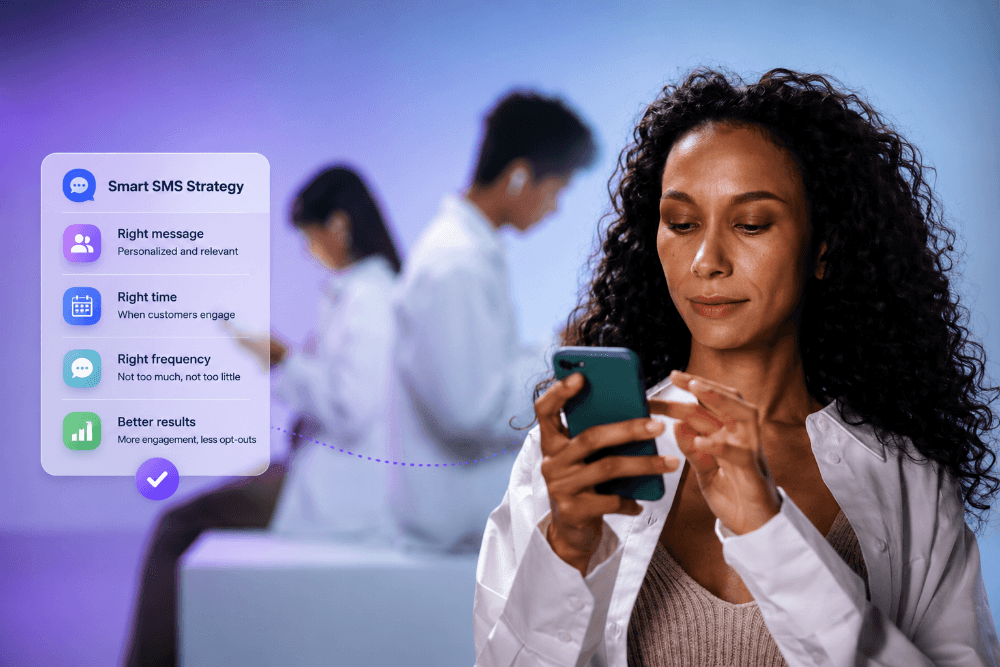
One of the hardest questions in SMS marketing sounds simple: How often should a business send text messages?
There is no universal number.
A restaurant promoting weekly specials has different communication needs from a furniture retailer where customers purchase only occasionally. Likewise, an appointment reminder differs greatly from a promotional flash sale.
Therefore, effective SMS frequency optimization depends on customer expectations, message value, purchasing behavior, engagement, and consent.
Sending too rarely can make subscribers forget why they joined. However, sending too often can create fatigue, increase opt-outs, and make even good offers feel intrusive.
The goal is not maximum messaging frequency. Instead, businesses should find the highest useful frequency each audience will welcome.
What Is SMS Frequency Optimization?
SMS frequency optimization is the process of determining how often individual subscribers or customer segments should receive text messages.
Rather than setting one fixed schedule for an entire list, marketers can adjust frequency according to factors such as:
- Customer engagement
- Purchase frequency
- Campaign type
- Customer lifecycle stage
- Recent SMS activity
- Message urgency
- Seasonal demand
- Customer preferences
- Opt-out behavior
For example, a highly engaged loyalty member might welcome several relevant texts per week during a major sale. Meanwhile, a customer who has ignored the previous six campaigns may need fewer messages.
Therefore, frequency should increasingly operate as a customer-level decision rather than a company-wide rule.
Is There an Ideal SMS Marketing Frequency?
Businesses often want a benchmark such as “send four texts per month.”
That can provide a starting point, but it should not become a permanent rule.
The right frequency depends heavily on what subscribers expected when they opted in. CTIA messaging principles emphasize that consumers should understand the nature of the messaging program and that senders should respect consumer preferences.
For a general promotional program, a business might start with a moderate cadence rather than sending every day.
However, message usefulness matters more than raw count.
Four repetitive discount messages may cause more fatigue than eight genuinely useful updates involving orders, appointments, loyalty rewards, and relevant offers.
Consequently, marketers should ask:
Does this subscriber have a good reason to receive this message now?
Different SMS Types Need Different Frequency Rules
Businesses should not treat every SMS as part of the same frequency calculation.
Transactional messages often happen because of customer actions. Promotional messages usually happen because the marketer decides to send them.
| SMS Type | Typical Trigger |
|---|---|
| Order confirmation | Customer purchase |
| Shipping update | Order status change |
| Appointment reminder | Upcoming appointment |
| Security code | Login request |
| Promotional campaign | Marketing schedule |
| Abandoned cart | Customer behavior |
| Loyalty reminder | Customer profile or timing |
A customer may receive five transactional texts during a delivery journey without feeling over-messaged because each update provides useful information.
However, five promotional texts in two days could feel excessive.
Therefore, businesses should monitor promotional pressure separately from necessary service communication.
Start With the Promise Made at Opt-In
Frequency optimization begins before the first campaign.
If the signup form says:
“Get 2–4 texts per month with new products and exclusive offers.”
customers enter the program with an expectation.
Suddenly increasing that cadence to 15 promotions per month changes the relationship.
Moreover, current A2P 10DLC registration practices expect recurring messaging programs to communicate message-frequency information during the consent process.
Therefore, marketers should make realistic frequency disclosures rather than promising an artificially low number that they cannot maintain.
If frequency varies significantly, clearly stating that message frequency varies can provide more flexibility while still setting expectations.
Engagement Should Influence Frequency
Subscribers tell businesses a great deal through their behavior.
Someone who consistently clicks SMS links, replies to messages, and purchases after campaigns demonstrates strong engagement.
Meanwhile, another contact may have ignored every text for three months.
Sending both people the same volume ignores those signals.
Useful Engagement Indicators Include:
- SMS clicks
- Replies
- Purchases
- Coupon redemptions
- Website visits after messages
- Recent activity
- Time since last SMS engagement
- Opt-down or unsubscribe behavior
A simple model could divide subscribers into three groups:
| Engagement Level | Frequency Strategy |
|---|---|
| High | Maintain or carefully test higher frequency |
| Medium | Use standard campaign cadence |
| Low | Reduce frequency and prioritize strongest messages |
As a result, businesses can spend more messaging budget on customers who show genuine interest while reducing fatigue among disengaged subscribers.
Purchase Frequency Should Shape SMS Cadence
The natural buying cycle also matters.
A quick-service restaurant may see the same customer several times per week. Too frequent promotions may still be useful.
In contrast, customers rarely buy mattresses every week.
Businesses should align SMS cadence with how often customers reasonably need their product or service.
For example:
Higher-frequency categories may include:
- Restaurants
- Grocery
- Fashion
- Entertainment
- Events
- Beauty services
Lower-frequency categories may include:
- Furniture
- Home renovation
- Automotive purchases
- Luxury goods
- Major appliances
However, lower purchase frequency does not mean businesses should disappear completely.
A furniture store could send design inspiration, seasonal collections, or maintenance tips instead of constant sales messages.
Therefore, content strategy and frequency strategy should work together.
Behavioral Triggers Can Replace Some Scheduled Campaigns
Businesses often over-message because they rely too heavily on calendar-based broadcasts.
For example:
Monday promotion.
Wednesday promotion.
Friday promotion.
Sunday promotion.
Behavioral messaging offers another approach.
Instead, Send When a Customer:
- Abandons a cart
- Views a product repeatedly
- Makes a purchase
- Reaches a loyalty milestone
- Books an appointment
- Becomes inactive
- Restocks a frequently purchased item
As a result, timing follows customer behavior rather than an arbitrary marketing calendar.
That can increase relevance while reducing the need for generic blasts.
Modern customer-journey platforms can trigger messaging based on real-time behaviors and continuously updated customer traits, making behavioral frequency management easier to automate.
Watch for Signs of SMS Fatigue
SMS fatigue occurs when subscribers receive more messages than they find useful.
The clearest warning sign is an increasing opt-out rate.
However, Marketers Should Also Monitor:
- Falling click-through rates
- Declining conversions
- Lower reply rates
- More STOP requests
- Complaints
- Reduced revenue per recipient
- Higher message volume without higher revenue
Suppose a business increases from four campaigns per month to eight.
Revenue rises from $40,000 to $46,000.
At first glance, the change looks successful.
However, total messaging costs double, opt-outs rise sharply, and revenue per message declines.
The higher frequency may therefore be reducing long-term efficiency.
Consequently, marketers should evaluate marginal performance, not just total revenue.
Measure Revenue per Message as Frequency Increases
A useful question is:
What did the additional campaign contribute?
Imagine this simplified example:
| Monthly Campaigns | Revenue | Revenue per Campaign |
|---|---|---|
| 4 | $40,000 | $10,000 |
| 6 | $52,000 | $8,667 |
| 8 | $56,000 | $7,000 |
| 10 | $57,000 | $5,700 |
Total revenue continues increasing. However, each additional campaign contributes less.
Eventually, another campaign may produce little incremental revenue while increasing unsubscribes and messaging costs.
Therefore, businesses should look for diminishing returns.
Holdout testing can strengthen this analysis by showing whether additional messages actually drive incremental purchases.
Use Frequency Caps Across Automated Journeys
Automation can unintentionally overwhelm customers.
Imagine someone simultaneously enters:
- Welcome flow
- Abandoned-cart flow
- Loyalty campaign
- Product-launch campaign
- Weekly newsletter promotion
Without coordination, one customer might receive several automated texts within hours.
A global frequency cap can prevent this problem.
For Example, a Business Might Set Rules Such as:
- No more than one promotional SMS per day.
- No more than three marketing texts within seven days.
- Suppress general campaigns during high-priority journeys.
The exact limits should depend on the program. However, the broader principle remains important: every automation should know what other automations are sending.
Therefore, frequency management should operate across the entire SMS program, not inside individual workflows.
Give Customers Frequency Preferences
Opt-out doesn’t have to be the customer’s only choice.
Some subscribers may still want messages—they want fewer of them.
A Preference Center Could Offer:
- All promotions
- Weekly highlights
- Major sales only
- Product alerts
- Loyalty updates
- Transactional messages only
Similarly, SMS interactions could let customers reduce frequency.
For example:
Getting too many texts? Reply WEEKLY to receive only our weekly highlights.
Consequently, an “opt-down” can preserve subscribers who might otherwise leave entirely.
It also produces useful first-party preference data for future segmentation.
AI Can Optimize Frequency at the Individual Level
Artificial intelligence can make frequency management more dynamic.
Instead of dividing everyone into three fixed schedules, predictive models can estimate how likely each customer is to engage with another message.
AI Can Consider:
- Recent SMS engagement
- Purchase likelihood
- Churn risk
- Customer value
- Previous message volume
- Time since last contact
- Preferred channel
- Offer sensitivity
A highly engaged customer with strong purchase intent may justify another message.
Meanwhile, someone with low engagement and high fatigue risk may enter a suppression period.
Therefore, AI-driven frequency optimization can shift the question from:
“How many SMS campaigns should we send this week?”
to:
“Should this specific customer receive another SMS right now?”
That is a much more useful decision.
Test Frequency With Controlled Experiments
Businesses should avoid changing frequency across the entire list based on intuition.
Instead, create test groups.
For Example:
- Group A receives two campaigns per month.
- Group B receives four.
- Group C receives six.
Then Compare:
- Conversion rate
- Revenue per subscriber
- Total revenue
- Opt-out rate
- Messaging cost
- Incremental revenue
- Customer lifetime value
Importantly, run the experiment long enough to capture both immediate purchases and potential subscriber fatigue.
A frequency increase that boosts revenue this week but causes many valuable customers to unsubscribe may hurt long-term performance.
SMS Frequency Best Practices
Businesses can improve frequency management with a few practical rules:
- Set expectations during opt-in.
- Separate promotional and transactional communication.
- Segment subscribers by engagement.
- Consider the natural purchase cycle.
- Use behavioral triggers where possible.
- Apply global frequency caps.
- Suppress irrelevant overlapping campaigns.
- Monitor STOP rates and engagement trends.
- Offer frequency preferences.
- Test higher and lower cadences.
- Measure incremental revenue, not only total revenue.
- Reduce messaging to disengaged contacts.
Most importantly, do not interpret permission as a reason to message constantly.
Consent means the customer allows communication. It does not mean every available campaign deserves a place in their inbox.

The Best SMS Frequency Is Different for Every Customer
No perfect number of marketing texts per week or month works for every business.
The ideal frequency depends on customer expectations, industry, engagement, purchasing patterns, message value, and timing.
Therefore, the smartest SMS programs will move away from rigid broadcast calendars.
Instead, they will use segmentation, behavior, preference data, frequency caps, experimentation, and increasingly AI to decide when another message actually adds value.
Sometimes optimization will recommend another text.
Other times, the best SMS marketing decision will be to send nothing.
Ultimately, businesses should aim for the point where customers still notice and value each message. When SMS frequency follows customer intent rather than marketing pressure, businesses can protect engagement, reduce opt-outs, control messaging costs, and build a healthier long-term subscriber base.