
SMS marketing can produce strong engagement, but sending more messages does not automatically create better results. Businesses must reach valid numbers, follow carrier rules, target relevant contacts, and control the cost of every message segment.
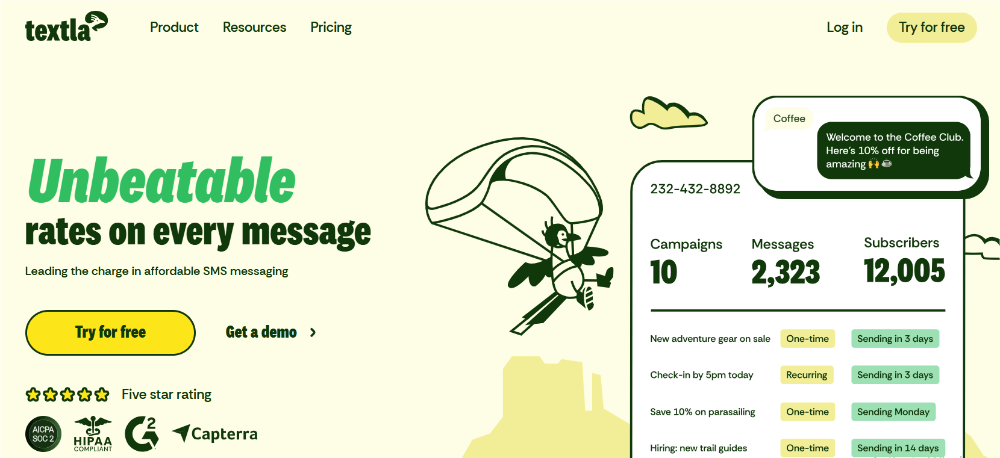
Textla addresses these priorities through low per-message pricing, contact segmentation, delivery analytics, list-cleaning tools, scheduling, personalization, and compliance-focused features. Consequently, small and growing businesses can run professional SMS campaigns without paying for a large bundle of unused monthly credits.
However, no platform can guarantee that every text will reach every recipient. Carrier filtering, invalid numbers, poor consent practices, message content, and phone availability all affect delivery. Textla’s main value lies in giving businesses practical tools to reduce avoidable failures and make messaging costs easier to understand.
What Is Textla?
Textla is a business texting platform for bulk SMS campaigns, direct messages, two-way conversations, contact management, keywords, and scheduled communication. Its online interface lets businesses import contacts, create targeted lists, personalize messages, send campaigns, and review delivery performance.
The platform focuses strongly on affordability. Textla currently combines a monthly platform subscription with pay-as-you-go message credits rather than requiring customers to purchase a fixed monthly message allowance. Therefore, companies only buy the credits they expect to use, while unused credits remain available as long as they maintain their Textla customer relationship.
Common Textla Use Cases Include:
- Promotional announcements
- Appointment reminders
- Event notifications
- Customer follow-ups
- Product-launch campaigns
- Review requests
- Employee alerts
- Two-way customer support
Transparent Pricing Makes SMS Budgets More Predictable
SMS platforms often use monthly packages that include a specific number of messages. Although these plans can work for consistent senders, businesses with seasonal or irregular campaigns may pay for credits they never use.
Textla takes a different approach. Its published plans charge a platform-access fee, while SMS usage follows a pay-as-you-go credit model. The company currently lists U.S. SMS messages at $0.01 per segment, while U.S. MMS messages use three credits. Canadian SMS and MMS pricing differs, so businesses should review destination-specific costs before launching international campaigns.
This structure helps businesses separate two important costs:
| Cost Type | What It Covers |
|---|---|
| Platform subscription | Access to campaign and account features |
| Message credits | Actual inbound and outbound SMS or MMS usage |
Consequently, a company can estimate campaign costs by multiplying the audience size by the expected number of billable segments. This visibility makes budgeting easier, especially for small businesses that cannot justify expensive enterprise plans.
The Segment Counter Helps Prevent Unexpected Charges
SMS pricing depends on segments rather than visual message count. A standard GSM-encoded text may use one segment when it stays within the normal character limit. However, longer messages are split into multiple billable segments.
Additionally, emojis and certain special characters can change the message encoding. Textla explains that messages containing an emoji may use 67-character segments, which means a seemingly short promotional text could consume two or more credits.
Therefore, businesses should watch the platform’s segment counter while writing campaigns.
For Example:
- One concise SMS to 5,000 contacts uses roughly 5,000 outgoing credits.
- A two-segment message to the same audience uses roughly 10,000 outgoing credits.
- An MMS campaign to 5,000 U.S. contacts uses roughly 15,000 credits.
Shortening unnecessary wording can immediately reduce costs. Moreover, marketers should use emojis only when they add enough value to justify the potential increase in segment usage.
Contact Segmentation Reduces Wasted Messages
The cheapest message is often the one a business does not need to send.
Textla allows users to organize contacts with tags, groups, keywords, audience filters, and exclusions. Therefore, a company can target customers based on their interests, location, campaign source, purchase status, or previous opt-in behavior instead of messaging the full database every time.
For Example, a Retailer Might Create Separate Groups for:
- New subscribers
- Repeat buyers
- Local customers
- Event attendees
- Customers interested in a specific category
- Subscribers who already redeemed an offer
A targeted campaign may reach fewer people, yet it can produce stronger engagement because the message matches the audience. Furthermore, excluding contacts who already completed the desired action prevents unnecessary sends and protects the customer experience.
List Cleaning Supports Better Deliverability
Outdated or invalid phone numbers waste credits and weaken campaign data. They can also create the impression that a campaign performs poorly when the real problem lies in contact quality.
Textla’s support resources include tools and guidance for auto-cleaning invalid numbers, managing contact statuses, interpreting error codes, and marking unusable contacts. Its contact-management system can therefore help businesses identify numbers that should not remain in future campaigns.
Businesses Should Still Maintain Their Own List-hygiene Process:
- Remove repeated hard failures.
- Import opted-out contacts correctly when migrating platforms.
- Avoid purchased or scraped phone lists.
- Review old contacts before major campaigns.
- Confirm that each subscriber provided valid consent.
As a result, more of the campaign budget goes toward reachable, interested recipients.
Delivery Analytics Reveal Campaign Problems
Textla includes delivery analytics across its paid plans. These reports help users understand whether messages reached carriers, failed, or encountered specific problems.
A high failure rate may point to invalid numbers, formatting issues, carrier restrictions, registration problems, or filtered content. For instance, Textla’s documentation explains that error 30007 can indicate that its filtering system or a carrier identified a message as spam or objectionable.
Therefore, businesses should not simply resend failed messages without investigating the reason. Instead, they should examine the error, review the content, check consent records, and confirm that their messaging program follows applicable carrier policies.
Delivery data can also help teams compare audience segments and campaign types. If one list regularly produces more errors, that segment may need cleaning before the next send.
Compliance Practices Protect Delivery Performance
Carriers actively filter suspicious, misleading, or noncompliant messaging. Consequently, deliverability depends partly on how responsibly a business builds and manages its SMS program.
Textla’s compliance guidance emphasizes clear consent, accurate sender identification, easy opt-outs, reasonable sending frequency, appropriate timing, and adherence to carrier rules. It also discusses U.S. 10DLC registration for businesses using standard 10-digit numbers.
Businesses Should Follow Several Basic Practices:
- Gain clear permission before sending marketing texts.
- Explain what subscribers will receive.
- Identify the business in each message.
- Process STOP and other opt-out requests.
- Avoid misleading links or claims.
- Respect quiet hours and regional requirements.
- Send content that matches the original opt-in.
Although compliance requires ongoing work, it supports both customer trust and long-term message delivery.
Scheduling and Recurring Campaigns Improve Efficiency
Textla’s Professional plan includes scheduled and recurring campaigns, personalized message fields, keywords, and access for multiple team members.
Scheduling helps businesses prepare campaigns during normal working hours while delivering them at a more appropriate time. Meanwhile, recurring campaigns can automate repetitive reminders, membership updates, or routine announcements.
Personalized fields also make messages more specific. For example, a clinic can insert a patient’s first name and appointment date, while a retailer can reference a relevant location or offer.
However, teams should review recurring campaigns regularly. Otherwise, outdated promotions or inaccurate details may continue sending automatically.
Zapier Adds Lightweight SMS Automation
Textla connects with Zapier, allowing businesses to trigger an individual SMS after an event in another application. For example, a company can send a text when someone submits a form, enters a CRM, or books an appointment.
The current Zapier integration supports single messages to individual contacts rather than bulk campaign creation. Nevertheless, it provides a practical automation option for confirmations, lead responses, and operational notifications.
Therefore, businesses can automate important one-to-one messages without commissioning a custom software integration.

Balancing Deliverability, Relevance, and Cost
Textla helps businesses control SMS spending through straightforward message rates, pay-as-you-go credits, segment visibility, audience filtering, and reusable campaign tools. Meanwhile, delivery analytics, invalid-number management, and compliance guidance help teams identify and reduce avoidable delivery problems.
Still, technology alone cannot create a healthy SMS program. Businesses must collect genuine consent, maintain accurate lists, write concise messages, target relevant audiences, and study campaign results.
Ultimately, Textla works best for businesses that want accessible SMS marketing without committing to large message bundles. By combining disciplined list management with careful segmentation and cost tracking, companies can send fewer wasted texts, improve campaign quality, and gain more value from every messaging dollar.