
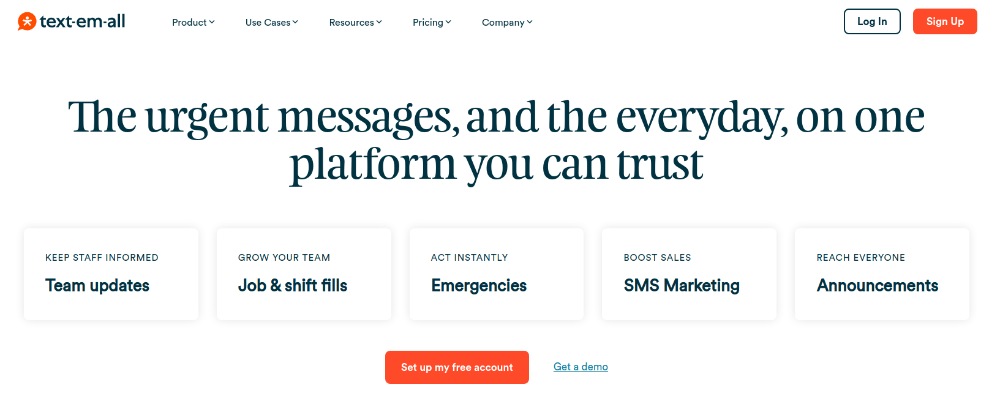
Organizations often need to reach hundreds or thousands of people at the same time. However, email may sit unread, manual calls require too much staff time, and group chats rarely offer the control or reporting that professional communication demands.
Text-Em-All addresses these challenges by combining mass texting, two-way SMS, and automated voice broadcasting in one web-based platform. Businesses, schools, healthcare providers, staffing agencies, nonprofits, and religious organizations can use it to deliver reminders, emergency alerts, employee updates, announcements, and promotional texts to opted-in audiences.
Moreover, Text-Em-All emphasizes ease of use, flexible pricing, compliance support, and human customer service. Therefore, it appeals to organizations that need reliable group communication without building a complicated messaging system.
What Is Text-Em-All?
Text-Em-All is a mass communication platform for sending SMS broadcasts, automated phone calls, and individual text conversations. Users can upload contacts, organize them into reusable groups, compose a message, and send it immediately or schedule it for later.
Each recipient receives a private message rather than joining a visible group conversation. Consequently, organizations can communicate at scale while protecting contact information and maintaining a professional experience.
The Platform Supports Several Common Use Cases:
- Emergency and weather alerts
- Appointment and payment reminders
- Employee updates and open-shift notifications
- School and community announcements
- Event reminders and changes
- Volunteer coordination
- Customer promotions
- Recruiting and staffing communication
Because the system handles both text and voice, teams can choose the channel that best fits the audience and urgency of each message.
Mass Texting Simplifies Large-Group Communication
Sending the same message manually to hundreds of contacts wastes time and increases the chance of errors. In contrast, Text-Em-All allows users to select a saved contact group and launch one broadcast to the entire audience.
The basic workflow remains straightforward:
- Upload contacts through a spreadsheet or add them manually.
- Write the message and add optional personalization.
- Select immediate or scheduled delivery.
- Review delivery results and incoming replies.
The platform identifies numbers that cannot receive texts and helps organize contact information before a broadcast. Additionally, users can create reusable groups, which makes future campaigns faster to prepare.
For example, a school could separate parents, teachers, transportation staff, and administrators. Similarly, a staffing agency could create groups based on location, skill, availability, or shift type. As a result, each audience receives information relevant to its needs.
Personalization Makes Broadcasts More Relevant
Mass communication does not need to sound impersonal. Text-Em-All supports personalization tags that insert details such as a recipient’s first name or other custom contact fields into a message.
- Instead of sending: “Your appointment is tomorrow.”
- A clinic could send: “Hi Daniel, your appointment is tomorrow at 10:30 a.m. Reply YES to confirm.”
The second message provides more value and feels closer to an individual conversation. Furthermore, organizations can store frequently used content in the Message Library as templates. Account owners can also share templates with other users, which helps teams maintain consistent language.
Two-Way Texting Turns Announcements Into Conversations
Some mass texting platforms focus only on outbound messages. However, Text-Em-All also supports two-way texting, allowing recipients to respond privately after receiving a broadcast.
Replies appear in a shared inbox where authorized team members can review, claim, and answer conversations. Therefore, a receptionist can confirm an appointment, a recruiter can discuss an open shift, or an event organizer can answer a last-minute question without using a personal phone number.
The mobile app further supports this workflow. Users can reply to contacts, review message histories, manage opt-outs, and move between business numbers from a smartphone while conversations remain synchronized with the web account.
Voice Broadcasting Reaches People SMS May Miss
Text messaging works well for most audiences, but it cannot reach every contact. Some people rely on landlines, check text messages infrequently, or respond better to a ringing phone.
Text-Em-All’s automated calling system sends prerecorded or text-to-speech messages to large contact lists without requiring staff members to dial each number. Organizations commonly use these calls for emergency alerts, appointment reminders, service notices, school closures, and shift updates.
Voice communication also conveys tone more clearly than a short text. Consequently, it may suit sensitive announcements, health-related updates, or urgent operational messages.
Users can create voice broadcasts through the online dashboard by choosing recipients, recording or generating the message, and selecting delivery settings. However, Text-Em-All does not allow promotional content through voice broadcasts, so organizations should reserve automated calls for informational communication.
Combined Text and Voice Broadcasts Expand Coverage
One of Text-Em-All’s most useful capabilities involves sending text and voice messages within the same broadcast.
By default, mobile numbers can receive texts while landlines receive voice calls. However, users can also configure a campaign to send both formats to mobile recipients when maximum coverage matters.
| Communication Need | Recommended Approach |
|---|---|
| Routine reminder | SMS broadcast |
| Emergency closure | Text and voice |
| Landline-heavy audience | Voice broadcast |
| Promotional offer | Opted-in SMS |
| Sensitive announcement | Recorded voice |
| Confirmation request | Two-way SMS |
For example, a utility company could text customers about planned maintenance while calling landline-only households. Likewise, a school could send an SMS alert and follow it with a voice message during severe weather. Therefore, organizations do not need to maintain separate systems for each channel.
Scheduling and Automation Reduce Repetitive Work
Text-Em-All lets users schedule broadcasts in advance. As a result, teams can prepare appointment reminders, event updates, deadline notices, and employee communications before they become urgent.
Keywords and automatic replies also handle common responses. A contact might text a selected keyword to join a list or receive an immediate reply. Meanwhile, keyword automation can manage routine answers such as confirmations without requiring staff to respond manually.
Event organizers, for instance, can schedule a save-the-date message, a one-week reminder, and a day-of update in advance. They can also attach maps, graphics, or QR codes through MMS.
Delivery Reports Provide Useful Visibility
Sending a broadcast does not guarantee that every contact received it. Therefore, Text-Em-All provides real-time reporting for text and voice campaigns.
Users can review delivery rates, failures, responses, and opt-outs. Furthermore, the platform explains why certain messages failed, helping teams identify invalid numbers or other contact-data problems.
This visibility improves future broadcasts. For example, an organization can remove outdated numbers, compare response patterns, and determine whether SMS, voice, or a combined campaign works best for a particular audience.
Built-In Compliance Tools Support Responsible Messaging
Organizations must gain appropriate consent before sending automated or promotional texts. Additionally, they must process opt-out requests quickly and follow carrier registration requirements.
Text-Em-All includes automatic opt-out suppression, compliant sending windows, and free 10DLC brand and campaign registration. It also identifies certain opt-out intentions even when a recipient does not write the exact word “STOP.”
Nevertheless, businesses remain responsible for maintaining valid consent records and sending only messages that match the recipient’s expectations.

Why Text-Em-All Stands Out
Text-Em-All provides a practical balance between simplicity and communication coverage. Mass texting helps organizations reach large groups quickly, while two-way messaging supports private follow-up conversations. Meanwhile, voice broadcasting reaches landlines and audiences that may overlook SMS.
Additionally, scheduling, templates, personalization, keyword automation, mobile access, compliance tools, and real-time reporting reduce the work involved in running repeated campaigns.
Ultimately, Text-Em-All represents a strong choice for organizations that need to deliver important messages without complex software. By combining text and voice in one accessible platform, it helps teams communicate faster, reach more people, and understand whether their messages arrived.