
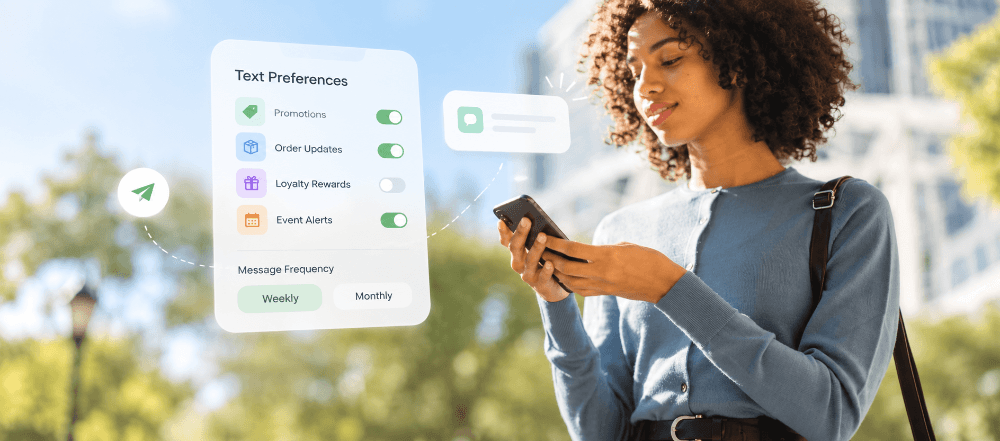
SMS marketing works best when customers feel that messages are useful rather than intrusive. However, many brands still treat texting as an all-or-nothing channel: subscribers either receive every campaign or opt out completely.
SMS preference centers offer a better approach.
Instead of forcing customers to choose between “everything” and “nothing,” a preference center lets them control the types of texts they receive, how often they receive them, and, in some cases, which topics, locations, or brands interest them.
As a result, businesses can reduce unnecessary messages while keeping more subscribers engaged. Moreover, preference management can improve personalization, consent records, and customer trust.
What Is an SMS Preference Center?
An SMS preference center is a page, form, or account setting where customers can manage their text-message preferences.
Depending on the business, customers may be able to choose:
- Promotional offers
- Order and delivery updates
- Appointment reminders
- Product launches
- Loyalty rewards
- Back-in-stock alerts
- Local store notifications
- Event announcements
- Educational content
- Message frequency
- Preferred locations or product categories
Therefore, the preference center becomes a bridge between broad SMS consent and highly personalized messaging.
For example, a customer might want shipping alerts and loyalty rewards but not weekly sales promotions. Another subscriber might want product launches but only for a specific category.
Instead of losing both customers to a full unsubscribe, a preference center gives each person more control.
Why SMS Preference Centers Are Trending
SMS programs have become more sophisticated. Businesses now use automated journeys, AI agents, behavioral triggers, loyalty campaigns, and omnichannel messaging.
However, increased automation can also increase message volume.
That creates a simple problem: even relevant brands can send too many texts.
Consequently, marketers are focusing more on preference management. Rather than maximizing send volume, they are trying to improve message relevance.
This shift also aligns with broader privacy expectations. Customers increasingly expect companies to explain how their data gets used and provide meaningful control over communication.
Moreover, U.S. FCC rules make consent revocation especially important. The FCC has clarified that consumers can revoke consent through reasonable means, including common reply terms such as STOP, CANCEL, and UNSUBSCRIBE.
Therefore, preference centers should complement standard opt-out mechanisms rather than replace them.
Preference Centers Can Reduce Full Opt-Outs
A customer who texts STOP may not necessarily dislike the brand.
They may receive too many promotional messages.
For example, imagine a retailer sends:
- Weekly discount messages
- Product launch alerts
- Loyalty reminders
- Local store updates
- Back-in-stock notifications
A subscriber may value two of those categories but dislike the others.
Without preference controls, the customer has only two choices: tolerate every message or unsubscribe from all of them.
With a preference center, the customer could disable promotions while keeping back-in-stock and loyalty alerts.
That creates a much better opportunity for retention.
| Subscriber Problem | Preference Center Solution |
|---|---|
| Too many texts | Reduce frequency |
| Irrelevant promotions | Select preferred topics |
| Multiple store alerts | Choose preferred location |
| Wants transactional only | Disable marketing categories |
| Interested in one product type | Select product interests |
| Temporary message overload | Pause selected communications |
Consequently, businesses can preserve relationships that might otherwise disappear through a full opt-out.
Let Customers Choose Message Categories
Message categories represent the foundation of a useful SMS preference center.
A retailer might offer categories such as:
Promotions
Discounts, limited-time offers, seasonal sales, and coupon codes.
Product Updates
New releases, back-in-stock notifications, and product availability.
Loyalty Messages
Points balances, member rewards, birthday offers, and VIP access.
Transactional Updates
Order confirmations, shipping alerts, appointment notices, and account information.
These categories help subscribers understand what they are agreeing to receive.
Moreover, clearer categories help marketers build cleaner audience segments.
Instead of sending one campaign to every SMS contact, teams can target only customers who explicitly selected the relevant topic.
Frequency Controls Can Improve the Customer Experience
Message relevance matters, but frequency matters too.
One customer may happily receive several texts each week. However, another may prefer only one or two updates per month.
Therefore, an SMS preference center can include options such as:
- All available messages
- Weekly highlights
- Monthly updates
- Important offers only
- Transactional messages only
Frequency preferences can help brands avoid subscriber fatigue.
For example, a customer who reduces frequency from three messages per week to one may remain subscribed for years. Without that option, the same customer might choose STOP out of frustration.
Additionally, marketers can use frequency preferences to create more efficient campaign calendars.
High-engagement subscribers may receive regular updates, while low-frequency subscribers receive only the strongest campaigns.
Preference Data Can Improve Personalization
Preference centers do more than prevent unsubscribes. They also generate valuable first-party data.
Instead of guessing what subscribers want based only on clicks or purchase history, marketers can ask.
A sporting goods retailer might let customers select:
- Running
- Cycling
- Hiking
- Fitness
- Camping
- Winter sports
Meanwhile, a travel company could ask customers to choose beach trips, city breaks, cruises, or family vacations.
As a result, businesses can create more relevant campaigns.
For example:
“New hiking boots just arrived” becomes much more useful when it goes specifically to subscribers who selected hiking.
Furthermore, explicit preference data can work alongside behavioral data. A customer may say they like running products while frequently browsing trail equipment. Together, those signals can create better segmentation.
Build Preference Centers Into the Opt-In Journey
Businesses should not wait until customers become frustrated before introducing communication choices.
Instead, preference collection can begin during signup.
A strong SMS signup flow might look like this:
- Customer enters a mobile number.
- The business explains the program clearly.
- The customer provides required consent.
- The confirmation message identifies the sender.
- The customer receives a link to manage preferences.
- The business stores those preferences with the subscriber record.
Industry guidance commonly emphasizes explaining message frequency and providing clear HELP and STOP instructions during SMS opt-in flows.
Therefore, preference management should be part of a broader consent strategy.
Do Not Hide the Full Opt-Out Option
A preference center should never make unsubscribing difficult.
Customers should still have a clear way to stop messaging completely.
In the United States, the FCC recognizes reply texts such as STOP, QUIT, END, REVOKE, OPT OUT, CANCEL, and UNSUBSCRIBE as reasonable methods for withdrawing consent.
Furthermore, senders cannot use a preference center to force customers through unnecessary steps before honoring a valid revocation request.
The FCC does allow a limited clarification message in certain situations when a subscriber has consented to multiple message categories. However, that clarification must not contain marketing content, and the sender must stop sending further consent-based messages if the consumer does not affirmatively choose to continue receiving messages in that category.
Therefore, preference centers should provide additional choice without weakening opt-out rights.
Make Preference Changes Easy to Find
A useful preference center should require very little effort.
Businesses can link to it from:
- Welcome texts
- Account settings
- Loyalty dashboards
- Email preference pages
- Customer profiles
- Selected promotional messages
For example:
“Want fewer texts? Manage your preferences here: [link]”
That wording gives the subscriber an alternative before frustration becomes an unsubscribe.
Additionally, the page should work well on mobile because nearly every visitor will arrive from a phone.
Keep forms short, use simple checkboxes or toggles, and save changes immediately.
Synchronize Preferences Across Marketing Systems
Preference management becomes difficult when SMS, email, CRM, e-commerce, and customer service tools store conflicting information.
Therefore, businesses should create a central preference record whenever possible.
For example, if a customer disables promotional SMS, that preference should be reflected in the system responsible for automated marketing journeys.
Likewise, if a subscriber changes their preferred store location, future local campaigns should reflect that selection.
A connected preference architecture may include:
- SMS platform
- CRM
- Customer data platform
- Ecommerce system
- Loyalty program
- Marketing automation software
Consequently, automation becomes safer and more accurate.
Without synchronization, an old workflow could continue sending a category the customer already disabled.
Measure Whether Preference Management Works
Businesses should track the performance of the preference center itself.
Useful metrics include:
| Metric | What It Reveals |
|---|---|
| Preference-page visits | How often subscribers seek more control |
| Preference updates | Whether customers use the available choices |
| Full opt-out rate | Whether unsubscribes decline |
| Category retention | Which message types customers value |
| Frequency changes | Whether sending volume feels excessive |
| Engagement by preference | Which self-selected audiences respond best |
For instance, if many subscribers switch to “monthly only,” the overall campaign frequency may be too aggressive.
Meanwhile, if a large percentage disable promotions while retaining loyalty alerts, the brand may need to improve the relevance of its promotions.
Therefore, preference data can become a useful marketing feedback loop.

SMS Preference Centers Are About Better Messaging, Not More Messaging
The strongest SMS programs will increasingly give customers more control.
Preference centers allow subscribers to choose the topics, frequency, and types of texts that fit their needs. Consequently, businesses can reduce irrelevant messages, improve segmentation, and preserve relationships that might otherwise end with a full unsubscribe.
However, preference management does not replace proper consent or straightforward opt-out processing.
Instead, it adds another layer of customer choice.
Ultimately, successful SMS marketing depends on relevance. A preference center helps brands learn what subscribers actually want rather than assuming every contact wants every campaign.
That simple shift can lead to fewer unwanted messages, stronger engagement, cleaner customer data, and a healthier long-term SMS program.