
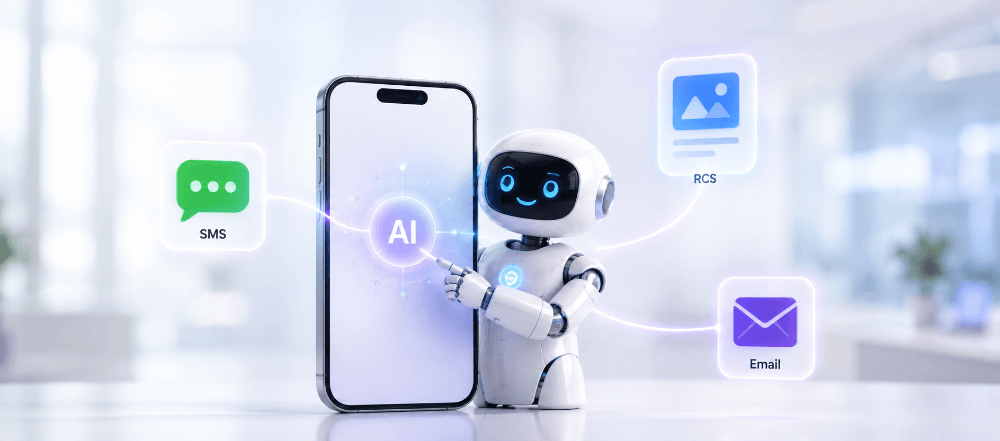
Customers rarely interact with a business through only one channel. They may discover an offer through email, receive an SMS reminder, open an RCS product carousel, and later ask an AI agent a question.
However, many businesses still manage these channels separately.
That creates repetitive campaigns, conflicting messages, and disconnected customer experiences. Omnichannel messaging solves this problem by coordinating SMS, RCS, email, and AI around one customer journey.
Instead of asking which channel should win, marketers can use each channel for what it does best. SMS provides reach and immediacy. RCS adds richer interaction. Email handles detailed content. Meanwhile, AI can determine what message, channel, and next action make sense for each customer.
As a result, messaging becomes more coordinated, responsive, and useful.
What Is Omnichannel Messaging?
Omnichannel messaging connects communication channels so they share customer context and work together as part of one experience.
The important word is connected.
A multichannel strategy may use SMS, email, and RCS at the same time. However, each channel may operate independently.
An omnichannel strategy coordinates them.
For Example:
- Customer abandons a shopping cart.
- Email provides product details.
- SMS sends a short reminder several hours later.
- RCS displays the products visually when supported.
- The customer replies with a question.
- An AI agent answers.
- The system stops all reminders after purchase.
Therefore, omnichannel messaging prevents a customer from receiving three identical promotions simply because three marketing systems operate independently.
What Role Does SMS Play?
SMS remains the broadest foundation for mobile messaging.
It works across virtually all mobile devices and doesn’t require customers to install an app. As a result, SMS remains particularly useful when reach, urgency, or simplicity matters most.
Businesses Commonly Use Sms for:
- Appointment reminders
- Order notifications
- Flash promotions
- Delivery alerts
- Payment reminders
- Authentication
- Customer-service follow-ups
- Time-sensitive calls to action
SMS also provides an important fallback when richer channels are unavailable.
For example, a company may try sending an RCS message first. If the customer’s device or carrier cannot receive RCS, the platform can deliver an SMS alternative instead.
As a result, SMS serves as the dependable foundation beneath more advanced messaging experiences.
RCS Adds Richer Mobile Experiences
Rich Communication Services expands what businesses can do inside the native messaging inbox.
RCS for Business can support verified sender identities, high-resolution media, rich cards, product carousels, suggested replies, and interactive actions.
Google’s RCS for Business specifications allow companies to combine text, images, video, and action buttons into rich cards. Businesses can also organize several cards into a carousel for product discovery and other interactive experiences.
As a result, RCS works well when customers benefit from visual information or multiple choices.
| SMS | RCS |
|---|---|
| Short, direct message | Rich interactive message |
| Links | Buttons |
| Basic text | Images and video |
| Broad compatibility | Growing compatibility |
| Excellent for alerts | Excellent for engagement |
| Universal fallback | Enhanced experience |
For example, SMS could remind a customer that a sale has started. Meanwhile, RCS could display four recommended products with photos and “Shop Now” buttons.
Email Handles More Detailed Communication
SMS and RCS work well for concise mobile interactions. However, some messages require considerably more space.
That is where email remains valuable.
Email Can Provide:
- Detailed product information
- Long-form educational content
- Receipts and documentation
- Newsletters
- Multiple product sections
- Guides
- Account summaries
- Detailed onboarding instructions
So email shouldn’t compete with SMS.
Instead, the two can reinforce each other.
Imagine a travel company sends an email containing a complete hotel reservation, cancellation conditions, airport-transfer information, and destination guide.
The day before departure, it sends an SMS:
“Your flight to Rome departs tomorrow at 9:20 AM. View your itinerary: [link].”
Email carries the detail. SMS provides the timely reminder.
That division creates a better experience than squeezing an entire itinerary into a text message.
AI Connects the Channels
AI changes omnichannel messaging because it can decide what should happen next.
Traditionally, marketers create rules such as:
“Ifcart abandoned, send email after one hour and SMS after 24 hours.”
That works, but every customer follows essentially the same predefined path.
AI can evaluate customer signals before deciding what to do next.
For Example, It May Consider:
- Previous SMS engagement
- Email opens
- RCS availability
- Purchase history
- Website activity
- Time since last purchase
- Customer preferences
- Predicted purchase intent
- Previous replies
The system can then decide that Customer A should receive SMS, Customer B should receive email, and Customer C should receive no message yet.
As a result, omnichannel orchestration moves from fixed sequences toward individualized decisions.
AI Can Choose the Best Channel
Different customers prefer different communication methods.
One subscriber may regularly click SMS promotions. Another may ignore text messages but purchase after email campaigns. Meanwhile, another customer may engage strongly with rich messaging.
AI can analyze historical behavior and estimate which channel is most likely to produce a useful interaction.
Twilio Segment, for example, documents channel-optimization workflows that use predictive models to classify customers by whether they convert more through SMS or email.
A Simplified Decision Could Look Like This:
| Customer Signal | Channel Choice |
|---|---|
| Strong SMS engagement | SMS |
| Detailed educational need | |
| RCS-supported + visual offer | RCS |
| Customer has a question | Conversational AI |
| Recent conversion | No promotional message |
Therefore, channel selection can become a customer-level decision rather than a campaign-wide assumption.
Omnichannel Journeys Prevent Repetitive Messaging
One of the biggest advantages of connected messaging involves suppression.
Suppose a retailer launches a weekend campaign through SMS and email.
The customer receives the email and purchases immediately.
Without connected data, the SMS platform might still send:
“Don’t miss our weekend offer!”
Several hours later.
That creates a poor experience.
With omnichannel orchestration, the purchase event updates the customer’s profile. The system then removes that customer from the promotional SMS sequence and starts a post-purchase journey.
As a result, customer activity controls messaging instead of each channel blindly following its own schedule.
AI Agents Turn Campaigns Into Conversations
AI can also add a conversational layer across channels.
Consider an RCS promotion for a new pair of shoes.
A customer asks:
“Do these run small?”
An AI agent can answer using approved product information.
The customer then asks:
“Can you send me the sizing guide?”
The agent could provide the link directly. If the guide requires more detailed information, it could also email it to the customer.
This lets the conversation move between channels based on the task.
AI Agents Can Also Help With:
- Product recommendations
- Appointment scheduling
- Lead qualification
- Order questions
- Account support
- Delivery updates
- Frequently asked questions
However, businesses should always define when the AI should hand the conversation to a person.
Customer Profiles Keep Everything Connected
Omnichannel messaging depends on a shared customer profile.
Without it, an SMS platform may know one part of the customer while the email platform knows another.
Useful Profile Data Can Include:
- Phone number
- Email address
- Customer ID
- SMS consent
- Email consent
- Purchase history
- Product interests
- Loyalty status
- Website activity
- Recent conversations
- Preferred channel
Customer-data platforms use identity resolution to combine identifiers and events from different systems into unified profiles.
For example, Twilio Segment uses identity graphs and customer identifiers to connect data across websites, applications, messaging channels, CRMs, and other sources.
As a result, marketers can make messaging decisions based on the customer’s broader relationship rather than one isolated campaign.
A Practical Omnichannel Customer Journey
Consider an e-commerce customer shopping for a new smartwatch.
Step 1: Email
The customer receives a personalized email with several watch recommendations.
Step 2: Website Behavior
They click one product and view it several times.
Step 3: SMS
The system identifies strong purchase intent and sends:
“The watch you viewed is still available. Need help choosing? Reply to this text.”
Step 4: AI Conversation
The customer replies:
“Is it waterproof?”
An AI agent answers from verified product specifications.
Step 5: RCS
If supported, the agent sends an RCS card showing the product, key specifications, and a “Buy Now” button.
Step 6: Purchase
The customer completes checkout.
Step 7: Suppression
All abandoned-product and promotional reminders stop.
Step 8: Email + SMS
Email provides the detailed receipt, while SMS sends the delivery update.
This is omnichannel messaging in practice: each channel does what it does best.
Consent Must Work Across Channels
Connected messaging does not mean one consent covers everything.
Businesses should track communication permission by channel and purpose.
For example:
- Promotional SMS: Yes
- Transactional SMS: Yes
- Promotional email: No
- RCS marketing: Yes
Furthermore, an AI agent should consult those preferences before initiating communication.
If a customer opts out of promotional SMS, the system should not simply move the same unwanted promotion to another texting number.
Likewise, channel orchestration should respect quiet hours, frequency limits, customer preferences, and applicable laws. Therefore, consent should become part of the customer profile and decision engine.
How to Build an Omnichannel Messaging Strategy
Businesses can begin without rebuilding every marketing system.
Start with these steps:
- Connect customer identities. Link phone numbers, emails, CRM IDs, and relevant account records.
- Centralize consent. Maintain clear permissions for each channel.
- Define each channel’s job. Use SMS for urgency, RCS for interaction, and email for depth.
- Track behavioral events. Capture clicks, purchases, replies, and browsing activity.
- Create suppression rules. Stop irrelevant campaigns after conversions or preference changes.
- Add AI selectively. Use AI for channel selection, recommendations, or conversations where it adds value.
- Keep human escalation available. Do not trap customers inside automation.
Most importantly, measure the entire journey rather than judging each channel only by its individual click rate.

The Future Is Coordinated Messaging
The future of customer messaging will not revolve around SMS replacing email or RCS replacing SMS.
Instead, businesses will coordinate them.
SMS will provide reach and immediacy. RCS will create richer mobile experiences. Email will provide depth and detailed content. Meanwhile, AI will increasingly decide what happens next and help customers continue conversations across channels.
As a result, marketing can become less repetitive and more responsive.
The most effective omnichannel systems will not ask, “How many messages can we send this customer?”
They will ask, “What does this customer need next, and which channel can deliver it best?”
That shift—from channel-first marketing to customer-first orchestration—will make SMS, RCS, email, and AI far more powerful when they work together.