
Marketing success often comes down to timing, relevance, and channel choice. Brands spend years refining their message. Yet many still send the right message through the wrong channel. As a result, engagement drops, conversions stall, and customers tune out.
SMS and email remain two of the most powerful direct marketing channels. However, they serve very different purposes. While both can drive strong results, they perform best under various conditions. Therefore, understanding when to use SMS and when to use email matters more than ever.
In this guide, we break down how each channel works, where each one shines, and how to combine them for better results across the customer journey.
Understanding the core differences between SMS and email
At a surface level, SMS and email look similar. Both deliver messages directly to customers. Both support links, personalization, and automation. However, their strengths diverge quickly once you examine how people actually use them.
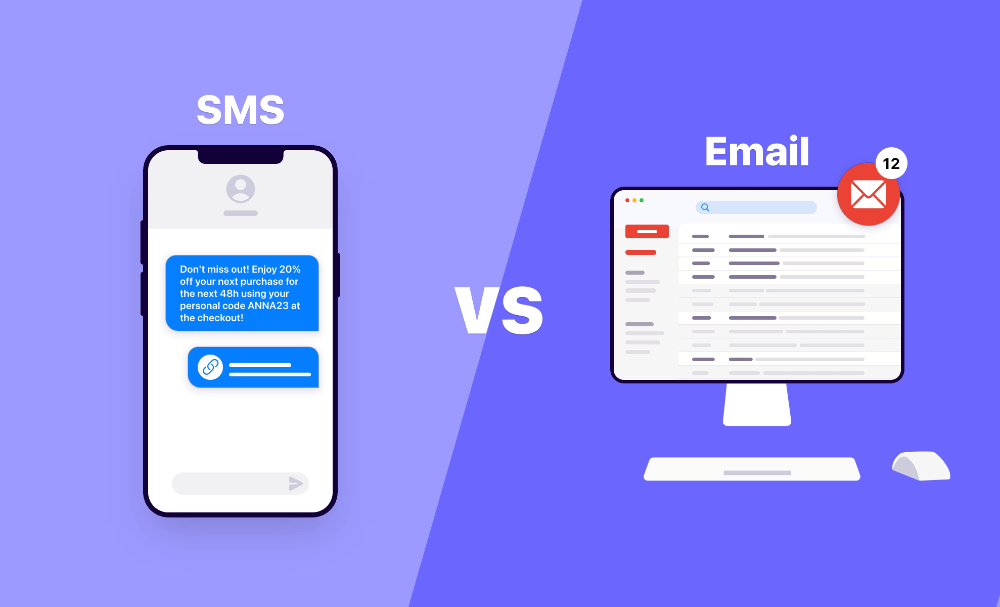
Email works as a destination. People open their inbox when they have time to read, browse, or research. Because of that, email supports longer content, detailed explanations, and visual storytelling. It also handles attachments, images, and structured layouts well.
SMS works as an interruption channel. People read texts almost immediately. They expect short messages. They expect clarity. And they often act quickly. Because of this, SMS performs best when urgency or immediacy matters.
So, while email supports depth, SMS supports action. Knowing this distinction sets the foundation for better channel decisions.
When email delivers better results
Email excels when the message requires context. If customers need to understand options, compare features, or absorb details, email provides the space they need.
For example, email works well for product launches that require explanation. You can include images, benefits, FAQs, and testimonials in a single message. Similarly, newsletters thrive in email because readers can skim sections at their own pace.
Email also supports brand storytelling. You can share your mission, highlight customer stories, and showcase behind-the-scenes content. Because readers choose when to engage, these messages feel less intrusive.
Additionally, email performs well for non-urgent promotions. If a sale runs for several days, email allows customers to revisit the message later. They can search for it. They can forward it. And they can save it for reference.
Therefore, email works best when time sensitivity stays low and information density stays high.
When SMS delivers better results
SMS performs best when timing matters. If the message loses value when delayed, SMS should lead.
For example, flash sales depend on speed. Appointment reminders require precision. Back-in-stock alerts demand immediacy. In these cases, SMS outperforms email because it reaches customers instantly.
SMS also shines when the desired action stays simple. A single link. A short confirmation. A quick reply. These actions align perfectly with text messaging behavior.
Moreover, SMS works well for transactional and operational updates. Shipping notifications, pickup alerts, and service updates reduce customer anxiety when delivered via text. Customers appreciate these messages because they remove uncertainty.
As a result, SMS often drives higher conversion rates when urgency, clarity, and speed matter most.
Attention and open rates shape channel performance
Attention remains the most valuable currency in marketing. SMS consistently commands attention because it lands in a highly personal space. People check texts quickly. They rarely ignore them entirely.
Email competes harder for attention. Inboxes fill up fast. Promotions pile up. Filters and tabs hide messages. As a result, even strong email campaigns can struggle to get noticed.
However, attention alone does not equal effectiveness. While SMS wins on opens, email still wins on depth. A customer may open a text quickly, yet rely on email to fully understand the offer.
Therefore, channel choice should reflect the message’s attention requirements and the time the customer should spend engaging with it.
Conversion paths differ between SMS and email.
Conversion behavior varies by channel. SMS encourages immediate action. Email supports delayed decision-making.
With SMS, customers often click the link within minutes. They respond while the message stays top of mind. As a result, SMS conversion paths tend to be shorter.
With email, customers may open the message multiple times. They may click later. They may revisit the content after comparing options. This longer path supports considered purchases and higher-value decisions.
So, if you need fast conversions, SMS often delivers better results. If you need informed conversions, email plays a stronger role.
Personalization works differently across channels

Both SMS and email support personalization. However, execution matters.
Email allows deeper personalization through content blocks, dynamic images, and long-form recommendations. You can tailor entire sections based on behavior or preferences.
SMS personalization stays lighter but feels more intimate. Using a name, referencing a recent action, or highlighting a specific product often feels more impactful in a short message.
Because SMS messages stay brief, relevance becomes critical. Every word must earn its place. As a result, personalization in SMS often feels sharper and more direct.
Therefore, brands should use email for layered personalization and SMS for precise, moment-based personalization.
Frequency tolerance differs by channel
Customers are increasingly tolerant of email and SMS. Many people expect daily emails during sales seasons. They rarely expect daily texts.
SMS demands restraint. Because it interrupts, overuse leads to opt-outs and frustration. Email, while still needing moderation, offers more flexibility.
So, when planning campaigns, frequency should guide channel choice. High-frequency educational or promotional content fits better in email. Low-frequency, high-impact messages fit SMS better.
How SMS and email work best together
The strongest strategies do not choose one channel over the other. Instead, they combine both with intention.
Email sets the stage. SMS cues action.
For example, an email can announce an upcoming sale and explain the details. Later, an SMS can remind customers when the sale goes live. As a result, customers receive context first and urgency second.
Similarly, email can nurture leads with helpful content. Then SMS can nudge them when a decision moment arrives. This pairing improves results without overwhelming the audience.
When both channels support each other, engagement rises across the entire journey.
Matching channels to customer journey stages
Different stages demand different communication styles. Early-stage awareness benefits from email because it allows storytelling and education. Mid-stage consideration benefits from email follow-ups and comparison content.
However, decision-stage moments benefit from SMS. Reminders, confirmations, and limited-time offers push customers toward action.
After purchase, both channels play a role. Email can deliver receipts, guides, and onboarding content. SMS can provide shipping updates, pickup alerts, and satisfaction checks.
By mapping channels to journey stages, brands create smoother experiences and better results.
Compliance and trust influence channel choice
Trust underpins both SMS and email marketing. However, SMS carries higher expectations.
Customers require explicit consent for texts. They expect an easy opt-out. They notice mistakes faster. Therefore, SMS programs must prioritize transparency and restraint.
Email also requires consent and compliance. Yet customers view email as less intrusive. This perception allows for broader messaging without immediate backlash.
So, when trust feels fragile or the message feels optional, email may feel safer. When trust feels strong and the message feels necessary, SMS can perform exceptionally well.
Common mistakes brands make with both channels
Many brands misuse SMS by treating it like email. They send long messages. They push too many offers. And they ignore timing. This erodes trust quickly.
Similarly, many brands misuse email, treating it solely as a broadcast tool. They skip segmentation. They overload content. And they fail to clearly guide action.
Better results come from respecting each channel’s nature. Short, urgent, and actionable messages belong in SMS. Detailed, educational, and exploratory messages belong in email.
Practical guidelines for choosing the right channel
To simplify decisions, consider these guiding questions. Does the message require immediate action? If yes, SMS fits better. Does the message require explanation? If yes, email fits better.
Is the message time-sensitive? SMS works well. Is the message informational or evergreen? Email works better.
Will the customer need to reference the message later? Email supports that behavior. Does the message support a single, simple action? SMS excels there.
Using these questions helps teams consistently choose the right channel.
Final thoughts
SMS and email are not rivals. They are complementary tools. Each channel excels when used for the right purpose at the right time.
Email builds understanding. SMS drives action. Email nurtures relationships. SMS delivers timely nudges. When brands respect these differences, engagement improves, and conversions rise.
The most effective strategies in modern marketing do not ask which channel is better. Instead, they ask which channel best fits this moment.