
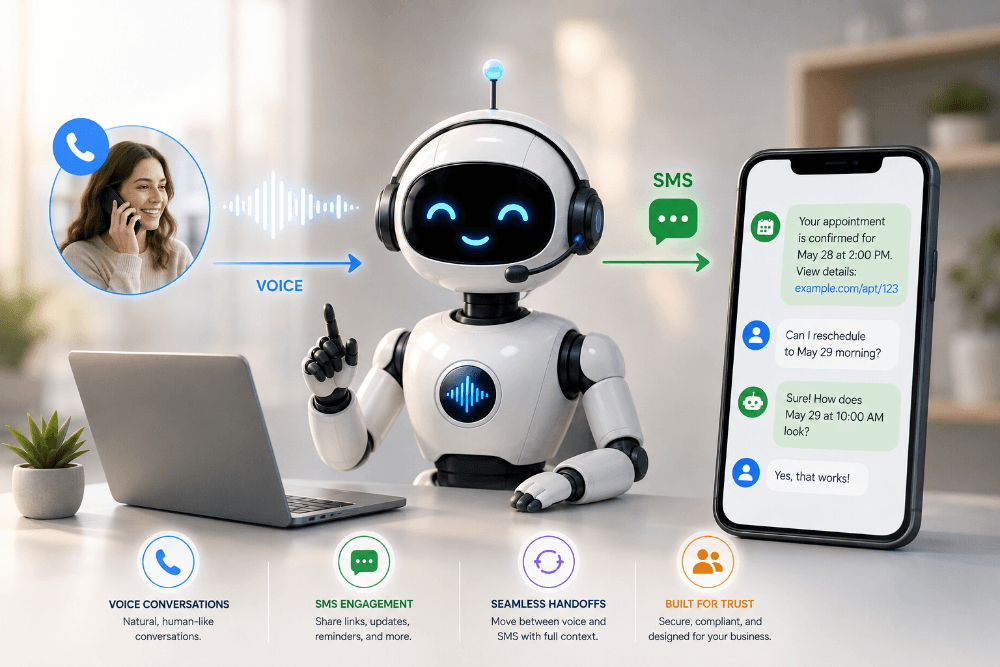
Customer communication no longer needs to live inside separate channels.
A customer might call a business, ask a question, receive a follow-up text, reply later by SMS, and then return to a voice conversation the next day. Traditionally, each interaction might exist in a different system. However, AI agents are making it easier to connect those moments into one continuous customer journey.
Modern AI voice agents can understand spoken language, access business data, use tools, and respond in real time. Meanwhile, SMS provides a persistent channel for confirmations, links, reminders, and asynchronous follow-up.
Together, voice and SMS create something more useful than either channel alone: an automated conversation that can move between speaking and texting while preserving customer context.
What Is an AI Voice Agent?
An AI voice agent is software that can conduct spoken conversations and complete approved tasks without a human employee managing every interaction.
Unlike a traditional interactive voice response system, which relies heavily on menus such as “Press 1 for sales,” an AI voice agent can understand natural-language requests.
For example, a customer might say:
“I need to move my appointment from Thursday afternoon to sometime Friday morning.”
The agent can interpret the request, check available appointments, suggest alternatives, and potentially reschedule the booking.
Modern voice infrastructure can also connect agents with tools such as CRMs, scheduling systems, databases, knowledge bases, and customer profiles. OpenAI’s current real-time voice models, for example, support speech-based applications that can reason and take action during a conversation.
As a result, voice agents are evolving from scripted call automation to task-oriented customer assistants.
Why Combine AI Voice Agents With SMS?
Voice and SMS solve different communication problems.
Voice works well when customers need to explain something, ask several questions, or make a decision through conversation.
SMS works better when customers need information they can save, click, reference, or respond to later.
| Voice Is Strong For | SMS Is Strong For |
|---|---|
| Complex questions | Confirmations |
| Detailed explanations | Links and documents |
| Urgent conversations | Appointment reminders |
| Qualification | Follow-up |
| Negotiation | Asynchronous replies |
| Emotional or nuanced issues | Quick status updates |
Combining the two channels lets the conversation shift formats based on what the customer needs.
A customer doesn’t need to stay on a phone call to copy a tracking link or appointment address.
A Voice Conversation Can Continue by SMS
Consider a customer calling a dental clinic.
They say:
“I’d like an appointment next Tuesday afternoon.”
The AI agent checks availability and books 2:30 p.m.
Instead of reading the address, appointment time, preparation instructions, and cancellation policy aloud, the agent can finish the call by saying:
“I’ve booked you for Tuesday at 2:30. I’ll text you the details now.”
The Sms Can Then Include:
- Appointment date and time
- Address
- Directions link
- Preparation instructions
- Rescheduling link
Voice handles the conversation, while SMS provides a permanent record.
Twilio’s Agent Connect currently supports both Voice and SMS through a common agent integration, allowing the same AI system to interact with customers through either channel.
SMS Can Also Start the Voice Journey
The relationship works in both directions.
Suppose a business sends:
“Your insurance renewal is coming up. Reply CALL if you’d like us to explain your options.”
The customer replies:
“CALL.”
An automated system can then initiate an outbound voice conversation.
Current agent infrastructure can support agent-initiated conversations across SMS and voice, including sending an SMS first or placing an outbound call.
This Creates Useful Workflows for:
- Lead qualification
- Renewal discussions
- Appointment scheduling
- Product consultations
- Customer retention
- High-value purchases
Therefore, businesses can start with a low-friction SMS and escalate to voice only when the conversation becomes complex enough to justify it.
Persistent Memory Makes Cross-Channel Conversations Better
One of the biggest problems in customer service occurs when customers have to repeat themselves.
They might explain a problem through text and then hear:
“Can you start from the beginning?”
when they call.
AI customer memory can reduce that friction.
Modern conversation platforms increasingly store summaries, customer traits, recent interactions, and relevant context so an AI agent can retrieve them when a customer returns.
Twilio’s Conversation Memory, for example, can provide an agent with customer profiles and communication history across interactions. Its Conversation Orchestrator can also maintain a unified model across Voice, SMS, WhatsApp, RCS, and chat.
Imagine This Journey:
- Customer reports a delivery problem by SMS.
- AI asks for the order number.
- Customer sends the information.
- The next day, the customer calls.
- The voice agent recognizes the customer.
- It already knows which order caused the problem.
As a result, the conversation feels continuous rather than fragmented.
AI Voice Agents Can Qualify Leads Before Sales Calls
Sales teams can also combine voice and SMS to automate early lead qualification.
Suppose someone requests information about solar installation.
An AI Voice Agent Could Call and Ask:
- Where is the property?
- Is it residential or commercial?
- What is the approximate energy usage?
- When does the customer want installation?
- Are they the property owner?
After the call, the system could send:
“Thanks for speaking with us. Your consultation is booked for Friday at 11 AM. Here is your preparation checklist: [link].”
The agent could also store the answers in the CRM.
As a result, human sales representatives start the next interaction with useful context instead of repeating basic questions.
SMS Follow-Ups Reduce Repetitive Voice Calls
Not every customer interaction requires another call.
For example, after a support conversation, an AI agent can send:
- Case numbers
- Reset instructions
- Payment links
- Tracking links
- Documentation
- Appointment confirmations
- Satisfaction surveys
This approach can reduce both customer effort and contact-center workload. Moreover, SMS allows customers to continue the conversation on their own schedule. Someone who cannot call again during work hours can reply later.
Therefore, SMS becomes the asynchronous extension of the voice agent.
AI Agents Can Use Business Tools Across Both Channels
The most valuable AI agents do more than talk.
They can use approved tools.
An Agent Might Access:
- CRM records
- Order management
- Appointment calendars
- Product inventory
- Pricing systems
- Customer accounts
- Knowledge bases
- Delivery tracking
For example, a customer could call and ask:
“Is the black version available?”
The AI agent checks inventory.
If the item is available, it could answer verbally and then send a product link by SMS.
Likewise, the customer could reply later:
“Can you reserve size 10?”
The same agent could continue the workflow through text.
Modern AI-agent infrastructure increasingly supports this tool-oriented approach. Twilio Agent Connect, for example, acts as middleware between LLM applications and communication channels while exposing customer context and tools to the agent.
Human Handoff Still Matters
Automating conversations does not mean businesses should eliminate human support.
Some interactions require judgment, empathy, authority, or specialized expertise.
Examples Include:
- Complex complaints
- Financial disputes
- Sensitive customer issues
- Negotiations
- Unusual technical problems
- High-value sales opportunities
Therefore, a strong AI system needs clear escalation rules.
Modern agent systems can transfer conversations from AI to human representatives while preserving context. Twilio, for example, supports human handoff for both Voice and digital channels such as SMS.
A practical division looks like this:
AI handles: FAQs, booking, qualification, routine updates, simple changes, and basic troubleshooting.
Humans handle: exceptions, disputes, sensitive conversations, and decisions outside the agent’s authority.
As a result, automation reduces repetitive work while keeping people available for the work that adds the most value.
AI Voice and SMS Can Improve Customer Support
Customer support provides one of the clearest use cases for combined voice and SMS.
A typical workflow might look like this:
- Customer calls with a problem.
- AI identifies the account.
- Agent diagnoses the issue.
- Agent sends troubleshooting steps by SMS.
- Customer tries the solution.
- Customer replies if the problem continues.
- AI continues by SMS or escalates to a person.
This workflow prevents customers from staying on hold while completing lengthy troubleshooting instructions. Additionally, the SMS thread gives the customer a written reference after the call ends.
Businesses Need Strong Safety and Permission Controls
Giving an AI agent access to voice, SMS, and business systems creates powerful automation. However, it also makes controls more important.
Businesses should define exactly what the agent can do.
For Example:
- Can it issue refunds?
- Can it modify reservations?
- Can it update customer details?
- Can it initiate outbound calls?
- Can it send promotional texts?
- Which actions require confirmation?
Moreover, SMS consent rules still apply. Permission to receive transactional updates does not necessarily mean a business can send unrelated promotional texts.
Businesses should also protect account information and authenticate customers before performing sensitive actions.
Importantly, not every agent framework suits every regulated workflow. Twilio notes that Agent Connect is not a HIPAA-eligible service or PCI-compliant product, so companies should evaluate their technical stack carefully for regulated use cases.
How to Build a Voice and SMS AI Workflow
Businesses should begin with one clearly defined customer journey rather than attempting full automation immediately.
1. Choose a Repetitive Use Case
Good starting points include appointment scheduling, lead qualification, order status, or basic customer support.
2. Decide When Voice or SMS Works Best
Use voice for conversation and SMS for links, confirmations, asynchronous replies, and permanent information.
3. Connect Only Necessary Business Systems
Give the agent access to the minimum tools required to complete their task.
4. Preserve Customer Context
Maintain conversation history so customers don’t have to restart every time they switch channels.
5. Define Human Escalation Rules
Make it clear when the agent should stop and transfer the customer.
6. Measure Outcomes
Track the following data:
- Resolution rate
- Call duration
- SMS reply rate
- Conversion rate
- Human escalation rate
- Appointment completion
- Customer satisfaction
This lets businesses evaluate whether the AI system improves the journey rather than simply increasing automation.

The Future Is One Conversation Across Multiple Channels
AI voice agents and SMS are most useful when businesses stop thinking about them as separate systems.
Customers may want to speak during one stage of the journey and text during another.
Voice can handle complex, natural interaction. Meanwhile, SMS provides persistence, speed, links, and convenient follow-up.
Modern agent platforms are increasingly designed around this idea of continuous, cross-channel conversations. Twilio’s current tools, for example, support a unified interaction model across voice, SMS, WhatsApp, RCS, and chat while preserving customer context.
Ultimately, the goal should not be to automate as many calls and texts as possible.
It should be to remove friction.
When AI voice agents and SMS share the same customer context, businesses can let conversations move naturally between speaking and texting while still providing human support when needed.
That creates a customer experience that feels less like navigating channels and more like continuing one useful conversation.