
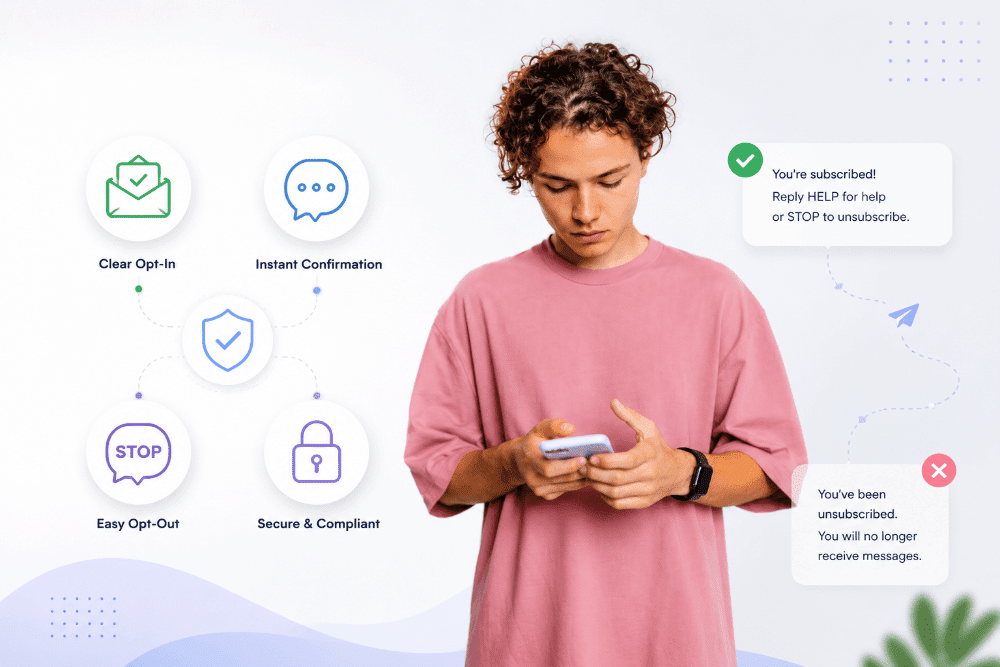
SMS marketing starts with permission.
Businesses may have sophisticated automation, AI personalization, and perfectly timed campaigns. However, those tools provide little long-term value if recipients never clearly agreed to receive messages or cannot easily stop them.
In 2027, SMS consent management should therefore sit at the center of every business texting strategy. U.S. carrier guidelines continue to emphasize consumer choice, while FCC rules also give consumers broad ways to revoke consent for covered automated texts.
Good consent management does more than reduce compliance risk. It improves list quality, reduces complaints, protects sender reputation, and gives marketers a clearer picture of who genuinely wants to engage.
What Is SMS Consent Management?
SMS consent management is the process of collecting, recording, updating, and honoring a customer’s permission to receive text messages.
It covers the entire permission lifecycle:
- A customer sees a clear SMS offer.
- The customer actively opts in.
- The business records when and how consent occurred.
- The customer receives confirmation.
- The business sends messages that match the original expectation.
- The customer can change preferences or opt out.
- The business suppresses further messages when consent ends.
Therefore, consent is not simply a checkbox saved during signup. It is an ongoing relationship between the sender and recipient.
CTIA’s current messaging principles emphasize obtaining opt-in consent before non-consumer messaging and maintaining mechanisms that allow recipients to opt out.
What Counts as a Good SMS Opt-In?
A strong SMS opt-in clearly tells people what they are agreeing to receive.
The customer should understand the brand sending the messages, the purpose of the program, and what kind of communication to expect.
Common opt-in methods include:
- Website signup forms
- Checkout checkboxes
- SMS keywords
- QR codes
- Loyalty enrollment
- In-store forms
- Account preference centers
- Point-of-sale signup
- Interactive phone systems
For example, a website might invite a customer to enter a mobile number and actively agree to receive promotional texts.
However, simply collecting a telephone number does not automatically create SMS marketing permission. A customer might provide their number for delivery updates, account security, or customer service without expecting promotional campaigns.
Therefore, businesses should connect consent to a clearly explained purpose. CTIA guidance also stresses that a consumer should understand the nature of the campaign when opting in.
Avoid Prechecked and Ambiguous Consent
The best SMS opt-in requires deliberate customer action.
For example, a checkout form should not quietly add someone to promotional SMS simply because they entered a mobile number to receive shipping notifications.
Instead, keep marketing consent distinct and visible.
A cleaner structure might say:
Mobile number: [number]
☐ Yes, send me promotional texts and special offers from Example Brand.
Supporting disclosure can then explain expected frequency, messaging rates, HELP instructions, and how to unsubscribe.
Moreover, the SMS disclosure should not disappear inside a lengthy privacy policy or unrelated terms. Consent performs better when customers clearly understand the value exchange.
Keep Proof of Every Opt-In
Businesses should be able to explain how a particular customer joined the SMS program.
That means maintaining consent records rather than storing only a status such as “subscribed.”
Useful consent records can include:
| Consent Data | Example |
|---|---|
| Phone number | +1 555 123 4567 |
| Opt-in source | Website checkout |
| Date and time | Oct. 8, 2026, 3:42 PM |
| Program | Promotional SMS |
| Disclosure version | SMS Terms v3 |
| Keyword | DEALS |
| Status | Subscribed |
| Opt-out date | If applicable |
If a customer questions why they received a message, the business can review the signup history.
CTIA also recommends maintaining opt-in and opt-out records so future messaging reflects consumer choices.
Send an Immediate Opt-In Confirmation
After someone subscribes, send a confirmation that clarifies the relationship.
For recurring A2P 10DLC campaigns, current registration guidance expects an opt-in confirmation that identifies the program or brand and explains message frequency, support, opt-out instructions, and potential message and data rates.
For example:
Example Brand: You’re subscribed to promotional texts. Message frequency varies. Msg & data rates may apply. Reply HELP for help or STOP to unsubscribe .
This message serves several purposes.
First, it confirms that signup worked. Furthermore, it reminds subscribers what they joined and gives them an immediate opportunity to leave if the registration happened accidentally.
Match Messages to the Original Consent
Consent should have context.
If a customer agrees to receive appointment reminders, that does not necessarily mean they expect weekly promotional discounts.
Likewise, permission for messages from Brand A should not automatically become permission for an unrelated Brand B.
CTIA specifically advises that opt-in permission should apply to the intended campaign and message sender, not be freely transferred or assigned. It also advises against using rented, sold, or shared opt-in lists for messaging campaigns.
Therefore, businesses should map consent by purpose when necessary.
A Customer Profile Could Contain:
- Transactional SMS: Yes
- Promotional SMS: No
- Appointment reminders: Yes
- Loyalty offers: Yes
This structure creates better personalization while reducing unwanted communication.
Make SMS Opt-Outs Extremely Easy
Customers should never have to search for a hidden unsubscribe form.
The most recognizable SMS opt-out instruction remains:
Reply STOP to unsubscribe.
However, businesses should not rely only on that exact uppercase word.
Current FCC rules recognize several reply terms—including stop, quit, end, revoke, opt out, cancel, and unsubscribe—as reasonable ways to communicate revocation for covered robotexts. Other natural-language requests may also indicate a customer’s intent.
CTIA similarly recommends processing normal language such as “please opt me out,” rather than rejecting requests over capitalization or minor wording differences.
Therefore, modern SMS systems should recognize intent rather than require customers to guess one perfect keyword.
What Should Happen After Someone Replies STOP?
The workflow should be simple.
- Detect the opt-out request.
- Update the customer’s consent status.
- Add the number to the appropriate suppression list.
- Send one confirmation.
- Stop future messages covered by the withdrawal.
For example:
Example Brand: You’ve been unsubscribed and will no longer receive these messages.
That final text should confirm the action rather than contain another promotion.
FCC rules permit a one-time confirmation of a revocation request provided it simply confirms the request and does not contain marketing material.
Furthermore, businesses should quickly synchronize suppression information across connected platforms. An unsubscribe loses its value if the SMS platform stops messaging while another CRM automation continues sending texts.
Centralize Consent Across Your Technology Stack
Modern customer journeys may involve a CRM, ecommerce store, customer-data platform, SMS provider, AI agent, booking system, and marketing automation software.
Consequently, fragmented consent creates risk.
Suppose someone replies STOP through the SMS provider. The SMS application recognizes the opt-out, but the CRM still lists the customer as “SMS subscribed.” Tomorrow, another automated workflow launches a promotional text.
A strong consent architecture should therefore establish one reliable consent state or synchronize changes across all systems.
Useful Statuses Might Include:
- Subscribed
- Transactional only
- Marketing subscribed
- Opted out
- Consent pending
- Invalid number
- Reassigned number
Moreover, each automated workflow should check the customer’s current permission before sending.
Treat AI Agents as Part of the Consent System
AI SMS agents will make consent management even more important in 2027.
An AI agent may understand messages such as:
“Please don’t send me sales texts anymore.”
The system should recognize that sentence as a preference or revocation signal, not a prompt to continue the marketing conversation.
Similarly, an agent should not persuade someone to remain subscribed after they clearly ask to stop.
Therefore, Businesses Should Give AI Agents Strict Rules:
- Detect opt-out intent.
- Stop promotional workflows immediately.
- Record the request.
- Trigger the correct confirmation.
- Never override suppression lists.
- Escalate ambiguous preference requests when necessary.
Automation should make consent easier to honor, not easier to bypass.
Keep Consent Data Clean
Phone numbers change owners. Customer preferences change. Moreover, subscribers who once wanted daily offers may later want fewer messages.
Businesses should regularly review:
- Deactivated phone numbers
- Duplicate contacts
- Conflicting consent records
- Unresponsive subscribers
- Old signup sources
- Failed messages
- Reassigned numbers
CTIA recommends regularly processing deactivated numbers and removing them from opt-in lists.
Furthermore, consider creating a preference center instead of offering customers only “everything” or “nothing.”
A subscriber may prefer weekly offers rather than daily messages. Giving customers control can preserve the relationship while reducing fatigue.
SMS Consent Best Practices for 2027
A strong consent program follows a few straightforward principles:
- Ask before texting.
- Explain what customers are joining.
- Separate marketing consent from unrelated phone-number collection.
- Record when, where, and how consent occurred.
- Send a clear confirmation.
- Keep messaging consistent with the original opt-in.
- Identify your brand clearly.
- Support STOP and natural-language opt-outs.
- Process revocation quickly.
- Maintain suppression lists.
- Synchronize consent across connected systems.
- Never use purchased or shared SMS lists.
- Regularly clean outdated contact data.
- Let customers control communication preferences.
Most importantly, treat consent as customer data, not a compliance formality.
SMS Consent Is Also a Marketing Advantage

SMS consent management may sound primarily legal or technical. However, it directly affects marketing performance.
Subscribers who knowingly choose to receive messages usually represent a more valuable audience than people added through unclear signup methods.
Meanwhile, easy opt-outs remove disengaged contacts, reduce unnecessary message costs, and protect list quality.
Therefore, marketers should not measure SMS success by subscriber count alone.
A smaller list of customers who understand the program, expect the messages, and want to remain subscribed can outperform a much larger database built through ambiguous consent.
In 2027, the strongest SMS programs will make permission visible at every stage of the customer journey.
Ask clearly. Record accurately. Respect preferences. Process opt-outs quickly.
When businesses follow those principles, SMS consent management becomes more than a compliance requirement—it becomes the foundation for trusted, sustainable, and effective text marketing.