
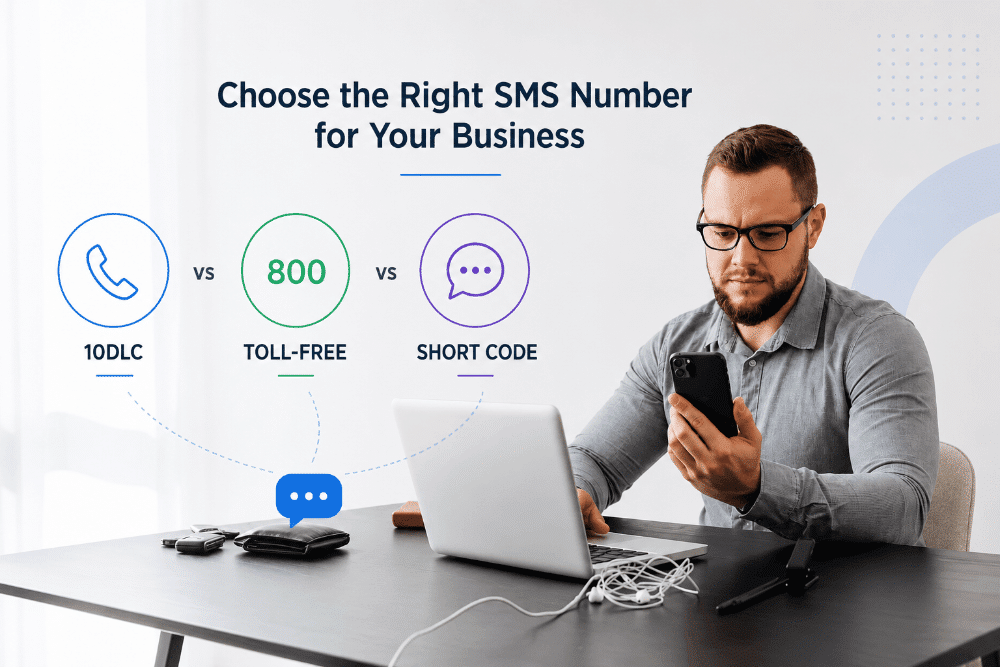
Businesses that want to send SMS in the United States quickly discover that choosing a texting platform is only part of the decision. They also need to choose how messages will reach customers.
Three common options are 10DLC, toll-free numbers, and short codes.
All three can support legitimate application-to-person, or A2P, business messaging. However, they differ significantly in cost, identity, throughput, registration, customer perception, voice support, and ideal use cases.
Therefore, the best choice depends on what the business wants to accomplish. A local service company may benefit from 10DLC, while a national customer-service operation may prefer toll-free texting. Meanwhile, very high-volume programs may justify a dedicated short code.
What Is 10DLC?
10DLC stands for 10-digit long code. It uses a standard local phone number, such as a number with a New York, Chicago, or Miami area code, for registered business messaging.
The biggest advantage is familiarity. Customers see a normal phone number rather than a five- or six-digit short code.
Additionally, 10DLC numbers can support both texting and voice. Therefore, a business can often use the same number for phone calls and customer SMS conversations.
Common Uses Include:
- Sales conversations
- Appointment reminders
- Lead follow-ups
- Customer support
- Local promotions
- Order updates
- Service notifications
- Two-way business texting
However, businesses sending A2P traffic to U.S. recipients must register their brand and messaging campaigns. Registration helps carriers identify legitimate traffic and generally provides better throughput and lower filtering than unregistered business traffic.
What Is Toll-Free SMS?
Toll-free SMS uses familiar numbers beginning with prefixes such as 800, 888, 877, 866, 855, 844, or 833.
Many established companies already advertise a toll-free customer-service number. Consequently, enabling SMS on that same number can create a unified communication experience.
A customer could text:
“Where is my order?”
Then, if the issue becomes complicated, the customer could call the same number.
This Combination Makes Toll-free Messaging Particularly Useful for:
- Customer service
- National brands
- Appointment management
- Transactional notifications
- Support conversations
- High-volume messaging
- Centralized business communications
However, toll-free business messaging also requires verification. For U.S. and Canadian messaging, unverified toll-free numbers cannot send SMS through providers such as Twilio; full verification is required before messaging begins.
What Is a Short Code?
A short code is a dedicated five- or six-digit number designed specifically for business messaging.
Consumers may recognize campaigns such as:
“Text DEALS to 12345.”
Because short codes contain fewer digits than normal phone numbers, they are easy to display in advertising and easy for customers to remember.
More importantly, short codes traditionally provide very high messaging throughput. As a result, they remain attractive for organizations that need to distribute enormous numbers of messages quickly.
Typical Short-code Use Cases Include:
- Large promotional campaigns
- One-time passwords
- Authentication
- Emergency alerts
- National marketing campaigns
- High-volume notifications
- Contests and text-to-join campaigns
However, short codes require more onboarding, carrier approval, and expense than the other options. Unlike 10DLC and toll-free numbers, they also do not support voice calls.
10DLC vs Toll-Free vs Short Code at a Glance
Each sender type fills a different role.
| Feature | 10DLC | Toll-Free | Short Code |
|---|---|---|---|
| Number format | Standard 10-digit local number | 10-digit 8XX number | 5–6 digits |
| Local identity | Excellent | Low | Low |
| Voice capable | Yes | Yes | No |
| Two-way SMS | Yes | Yes | Yes |
| MMS support | Yes | Yes | Yes |
| High-volume potential | Good | High | Very high |
| Setup cost | Lower | Lower | Highest |
| Easy to remember | Familiar | Familiar | Excellent |
| Best for conversations | Excellent | Excellent | More limited |
| Typical use | Local/customer engagement | National support and messaging | Massive-volume campaigns |
Importantly, throughput varies by provider, campaign, carrier, registration, and messaging program. Therefore, businesses should confirm current limits before designing capacity around a specific sender type.
Why Choose 10DLC?
For many small and midsize businesses, 10DLC offers the most natural starting point.
A local number makes conversations feel familiar. For instance, a Chicago plumbing company could text customers from a Chicago-area number rather than an unfamiliar national sender.
Moreover, 10DLC works especially well when customers may reply and expect a person to continue the conversation.
A Typical Journey Could Include:
- Customer requests a quote.
- Business sends an SMS confirmation.
- Customer replies with a question.
- Sales representative answers.
- Customer schedules the service.
- The same number sends an appointment reminder.
As a result, 10DLC works well for relationship-based business texting.
Another advantage is cost. Compared with dedicated short codes, local numbers generally cost much less per month, though businesses must account for registration, campaign, carrier, and per-message fees.
When Toll-Free SMS Makes More Sense
Toll-free messaging becomes especially attractive when a business has a national rather than local identity.
Imagine an ecommerce company serving customers across all 50 states. A local area code may not provide much value. Instead, an 800-style number can represent the company as a whole.
Furthermore, the same toll-free number can support both voice and text.
That creates a smooth support experience:
SMS: “Your order has been delayed. Reply HELP if you need assistance.”
Customer: “I need to change the delivery address.”
If the issue requires more discussion, the customer can call the same number.
Twilio also notes that toll-free messaging provides handset-level delivery receipts, whereas 10DLC delivery receipts generally reflect carrier-level delivery. Therefore, toll-free messaging can offer useful additional delivery visibility for some businesses.
When Short Codes Are Worth the Higher Cost
Short codes make the most sense when scale and speed justify the added investment.
Suppose a national retailer needs to distribute millions of Black Friday notifications within a short period. A short code can handle extremely high-volume traffic while providing a recognizable SMS identity.
Likewise, companies often use short codes for authentication or urgent alerts because throughput and delivery reliability matter more than conversational appearance.
Bandwidth currently describes short codes as offering some of the highest throughput and strongest reliability among U.S. business messaging options.
However, these advantages come at a price. Dedicated short codes commonly involve substantial monthly lease costs in addition to messaging charges, and approval can take considerably longer than setting up other sender types.
So a small company sending 10,000 appointment reminders probably doesn’t need one.
Which Is Best for Two-Way Business Texting?
For conversational messaging, 10DLC and toll-free numbers usually make the strongest choices.
Both look like regular phone numbers, support replies, and can also support voice.
10DLC has an advantage when local identity matters.
Toll-free has an advantage when the company operates under one national identity.
Short codes still support inbound replies, but customers often associate them with automated campaigns rather than personal conversations. Therefore, they fit better when the main goal involves scale rather than relationship-based messaging.
Which Is Best for SMS Marketing?
The answer depends largely on campaign volume.
For most small and medium-sized marketing programs, 10DLC provides a practical balance of affordability, conversational capability, and local identity.
Meanwhile, toll-free can work particularly well for national brands that want one recognizable sender across marketing, notifications, and customer support.
Short codes become more compelling when enormous send volumes, fast distribution, or memorable text-to-join campaigns justify the additional cost.
Therefore, marketers should avoid choosing short codes simply because they appear more “enterprise.”
The sender should match the actual communication requirement.
Registration and Consent Apply to Every Option
A common mistake is assuming that switching number types allows businesses to avoid compliance requirements.
It does not.
10DLC requires brand and campaign registration. Toll-free numbers require messaging verification. Meanwhile, short-code programs go through their own approval and provisioning processes.
Furthermore, every sender still needs a responsible consent strategy.
CTIA’s principles emphasize wanted communication and consumer protection from unwanted messages. Therefore, businesses should maintain clear opt-in processes, identify themselves, honor opt-outs, and send content consistent with what subscribers agreed to receive.
No sender type turns an unwanted campaign into legitimate messaging.
Can a Business Use More Than One Sender Type?
Yes, and larger organizations often benefit from doing exactly that.
A company could use:
- 10DLC for individual sales conversations
- Toll-free SMS for nationwide customer support
- Short codes for high-volume alerts or authentication
For example, a healthcare organization could use a short code for high-volume authentication, a toll-free number for appointment notifications, and local 10DLC numbers for conversations with individual clinics.
So businesses don’t always need one winner.
Bandwidth has seen organizations use different sender types at different stages and for different purposes within the same customer journey.

Which Business Texting Option Should You Choose?
A simple decision framework can help.
Choose 10DLC if:
- Local identity matters.
- You expect frequent two-way conversations.
- You want a voice-capable local number.
- Your volume does not justify a short code.
Choose toll-free if:
- You operate nationally.
- You want one central business identity.
- Customers may switch between calls and texts.
- You need substantial messaging capacity.
Choose a short code if:
- You send extremely high volumes.
- Rapid distribution matters.
- You run national text-to-join campaigns.
- You can justify higher costs and longer provisioning.
Ultimately, no option is universally superior.
10DLC excels at local and conversational communication. Toll-free numbers combine nationwide recognition with texting and voice. Short codes provide a dedicated, memorable channel designed for serious messaging scale.
Therefore, businesses should start with the customer journey, not the number type.
Ask how customers will interact, how many messages you need to send, whether customers will reply or call, and how quickly messages must arrive. Once those questions are clear, choosing between 10DLC, toll-free SMS, and short codes becomes much easier.